

A padel court can have premium steelwork, panoramic glass and excellent lighting, yet still disappoint players if the playing surface is poorly specified. The choice between sand infill versus non-infill turf affects how the ball travels, how securely players move, how the court drains and what operators spend maintaining it over its working life.
For clubs, developers and operators, this is not simply a choice of carpet. It is a decision about player experience, operating conditions and the long-term reliability of a revenue-generating asset.
What sand infill does on a padel court
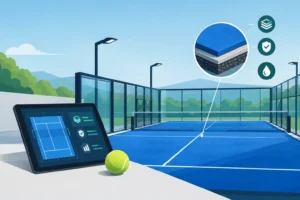
Sand-infill turf uses artificial grass fibres supported by a measured quantity of kiln-dried silica sand. The sand sits between the fibres rather than on top of the surface. Its purpose is to add ballast, support the yarn, influence ball behaviour and help create the controlled footing expected on a dedicated padel court.
A professionally specified padel turf system normally uses a short, dense pile designed for the sport. The exact sand quantity depends on the product, pile height, fibre construction and intended playing characteristics. More sand is not automatically better. Incorrect infill levels can leave fibres unsupported, make the surface feel heavy or create uneven areas that affect bounce and player confidence.
The principal advantage is stability. Sand helps the turf remain flat and secure under repeated lateral movement, sharp changes of direction and the concentrated traffic found around the service boxes and net. It also helps the fibres recover after play, maintaining a more consistent surface across the court.
For many commercial padel facilities, sand-infill turf remains the established choice because it delivers familiar ball speed, reliable grip and a proven maintenance model. It is particularly well suited to busy clubs where consistency from one court to the next matters as much as first impressions.
Playing characteristics and player confidence
Padel is played at pace in a compact space, with frequent pivots, short sprints and low defensive movements near the glass. Players need enough traction to accelerate, but not so much that the surface feels overly restrictive. A correctly installed sand-infill system provides a balanced, predictable interaction between footwear and turf.
Ball bounce is equally important. The surface must work with the underlying slab and the court’s overall construction to produce a controlled, repeatable response. When infill is distributed evenly, the ball generally reacts more consistently than it would on a surface with worn patches, raised fibres or areas where the backing has become exposed.
This consistency carries commercial value. Members and guests may not describe the fibre profile or silica grading, but they immediately recognise whether a court feels professional underfoot.
Non-infill turf: where it can work
Non-infill turf is designed to operate without sand or with only minimal dressing. It can offer a cleaner visual appearance and removes the need for sand redistribution during routine maintenance. For certain leisure, multi-sport or low-intensity applications, that simplicity can be attractive.
On a padel court, however, the specification needs closer scrutiny. Non-infill products rely on fibre density, yarn shape, backing design and the quality of the sub-base to deliver stability and playability. A product that performs well in a display area or on a light-use recreational surface may not provide the controlled traction and ball response required for intensive padel.
The appeal is understandable. With no loose sand, there is less risk of infill being carried into walkways, changing areas or hospitality spaces. The court may also appear tidier between cleans, particularly at venues where staff resources are limited. But a clean appearance should not be confused with lower technical risk.
For premium padel projects, non-infill turf should be selected only where the manufacturer can demonstrate that the surface has been developed and tested for padel movement, bounce and expected traffic levels. The decision should follow a full review of the venue, not a preference based solely on appearance.
The trade-off beneath the surface
Without sand to support the fibres, some non-infill systems can flatten more quickly in high-wear zones. This may alter traction and make the court look tired earlier than expected. Depending on the product, the surface can also feel firmer or produce a ball response that differs from what regular padel players expect.
That does not mean every non-infill product is unsuitable. Advances in fibre engineering continue to expand the range of available surfaces. It does mean that operators should ask detailed questions about pile recovery, wear testing, drainage, UV resistance, warranty conditions and the recommended cleaning routine before approving a specification.
Sand infill versus non-infill turf: the operational comparison
The right surface depends on the court’s use profile, location and commercial position. A flagship indoor club with high player throughput has different requirements from a seasonal hotel court or a private development with limited daily use.
Sand-infill turf usually requires periodic brushing to redistribute infill and lift the fibres. Operators must also remove leaves, debris and contaminants, while monitoring infill levels in the busiest areas. This is routine work, not a flaw in the system. When it is included in the operating plan, it protects playing quality and extends the visual life of the surface.
Non-infill turf removes the task of managing loose sand, but it still needs cleaning and brushing appropriate to the manufacturer’s instructions. Dirt, organic material and compacted debris can affect drainage and surface grip on any turf system. A lower-maintenance claim should therefore be tested against the full care schedule, not just the absence of sand.
Installation accuracy matters in both cases. The turf must sit on a flat, well-prepared base, with secure joins and correct tension. On sand-infill systems, the infill must be applied evenly and brought to the specified depth. On non-infill systems, the base tolerance and adhesion or fixing method become particularly important because there is less material available to compensate for minor irregularities.
Drainage, weather and covered padel courts
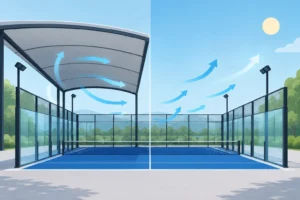
Outdoor padel courts need a surface and foundation designed to move water away efficiently. Turf alone does not solve drainage. The whole build-up – from the finished court level and slab falls to the drainage strategy around the structure – determines whether a court remains playable after rainfall.
Sand-infill turf can drain effectively when the sand is clean and correctly maintained. Fine debris, moss and compacted material can reduce permeability over time, particularly beneath trees or in poorly maintained locations. Regular surface care is therefore part of drainage protection.
Non-infill turf can also perform well in wet conditions, but the backing and underlying construction must be matched carefully. Water that cannot escape through the system will affect play regardless of whether sand is present.
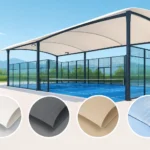
Canopy-covered courts reduce direct rainfall and help operators protect booking revenue in variable British weather. They do not remove the need for a properly engineered outdoor drainage strategy. Wind-driven rain, cleaning water, condensation and moisture around the perimeter still need to be managed correctly.
Choosing a surface for your investment model
A club aiming to attract experienced players, league activity and regular coaching should prioritise a recognised padel playing specification over the perceived convenience of a sand-free surface. Consistent traction, dependable bounce and durable presentation support repeat bookings and positive member feedback.
For a hospitality venue or mixed-use development, visual cleanliness may carry more weight, especially where courts sit close to pool decks, terraces or premium communal areas. Even then, decision-makers should assess how often the court will be used and whether the chosen non-infill product is engineered for genuine padel performance.
The wider court system should also guide the choice. Premium panoramic courts place the playing area at the centre of the customer experience. Clear sightlines, strong structural detailing, quality glass and the turf work together. A surface that looks attractive on opening day but deteriorates under use weakens the entire investment.
At inCourts, surface selection is considered alongside court structure, site conditions and the operational ambitions of the facility. The objective is not to promote a material in isolation, but to specify a court that performs reliably and presents to the standard expected by players and investors.
Before committing, request clear information on the turf’s intended sport, fibre construction, infill requirement, maintenance regime, warranty and compatibility with the proposed base. The strongest padel projects make this decision early, then build every other element of the court around a surface designed to keep earning confidence long after opening day.


No comment yet, add your voice below!