

A padel court can have premium glass, a strong steel structure and an excellent playing surface, yet still disappoint members after sunset if the lighting is poorly specified. Padel lighting is not a finishing extra. It is a core operating system that shapes ball visibility, player comfort, booking hours and the perceived quality of the entire facility.
For clubs, developers and operators, the right approach is to specify lighting as part of the court infrastructure from the outset. This avoids expensive alterations later, protects the visual quality of a flagship installation and gives players the confidence to play consistently through evenings and darker months.
Why padel lighting is a commercial decision
Evening availability is central to the business case for many padel facilities. Work, school and travel patterns mean peak demand often begins when natural light is fading. A court that cannot offer clear, comfortable play after dark loses valuable bookable hours precisely when demand is strongest.
Lighting also affects retention. Players may not describe a poor installation in technical terms, but they notice glare when serving, dark areas near the rear glass, inconsistent visibility against fencing and light spill that makes the court feel less refined. Those details influence whether a venue feels professional and whether customers return.
For hospitality venues, residential developments and municipal projects, the considerations are wider still. The system must support safe use, respect neighbouring properties, suit local planning conditions and present an attractive appearance in daylight as well as at night. The lowest initial fixture price rarely represents the lowest lifetime cost.
What good padel court lighting should achieve
A successful lighting design creates even illumination across the whole playing area without forcing players to look directly into intense light sources. In padel, the ball can travel quickly from high lobs to low rebounds off glass and mesh. Players need to track it clearly at every stage of a point, from the service box to the corners behind the baseline.
Uniformity matters as much as headline brightness. A court may appear bright when viewed from outside, yet still contain abrupt shifts between illuminated and dimmer zones. This makes distance and ball speed harder to judge. A competent design considers the playing surface, the volume above the court and the ball trajectories created by defensive lobs and aggressive overhead shots.
Glare control is equally important. Floodlights should be positioned and aimed to deliver useful light to the court rather than creating a distracting source in a player’s line of sight. The effect is particularly noticeable when a player looks up for a bandeja, vibora or smash. Better optics, sensible mounting heights and precise aiming all contribute to a more comfortable result.
Colour quality should support clear visual contrast. Modern LED systems can deliver a clean, natural-looking light that helps players distinguish the ball, lines, glass and surroundings. Extremely cold or harsh light can make a court feel clinical, while poor colour rendering can reduce definition. The preferred specification depends on the site and the intended standard of play, but it should be chosen deliberately rather than treated as an afterthought.
LED padel lighting and its long-term value
LED technology is now the practical choice for new padel projects. Compared with older discharge systems, a well-specified LED installation uses less energy, reaches full output immediately and generally requires less maintenance. For an operator with multiple courts and long evening opening hours, the operating difference can be substantial.
However, LED is a category, not a guarantee of performance. Cheap fittings may promise high output but offer poor optical control, inconsistent driver quality or limited protection from moisture and dust. Replacing failed fittings at height is disruptive, particularly in a busy club calendar. It can also undermine the clean visual presentation of a premium court.
Assess the fixture as a complete component: housing quality, thermal management, ingress protection, corrosion resistance, driver reliability and the availability of replacement parts all matter. This is especially relevant for coastal locations, exposed rooftop settings and outdoor venues subject to frequent rain or severe temperature changes.
Control systems deserve attention too. Basic switching may be appropriate for a single private court, but commercial facilities usually benefit from more flexible control. Timed schedules, booking-system integration, grouped court control and carefully managed dimming can reduce wasted consumption without compromising the player experience. The best option depends on opening hours, staffing arrangements and the number of courts, so controls should be matched to the operating model.
Integrating lighting with court structure and canopy design
Lighting should be designed alongside the court, not attached after installation has been completed. The location of columns or structural mounting points affects sightlines, steelwork loads, cabling routes, maintenance access and the overall visual balance of the court.
On panoramic courts, integration is particularly important. These court models are selected for their open views, premium appearance and spectator appeal. Poorly placed columns or visible cabling can interrupt that effect. A coordinated solution preserves the clean lines of the structure while keeping fixtures in the correct position for play.
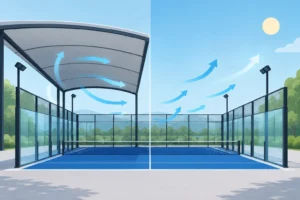
Covered courts add another layer of planning. A padel canopy extends playing hours and protects the customer experience from rain, but its roof structure changes how light is distributed. Fixture mounting height, roof reflectance, shadows from beams and emergency lighting provision should all be considered during engineering. A canopy cannot simply be treated as a roof placed over an outdoor lighting layout.
Cable management is another detail that separates a considered installation from an improvised one. Routes should be protected, accessible for inspection and visually discreet. Power distribution, isolators and control equipment must be planned around site access and local electrical requirements. These are not glamorous decisions, but they protect reliability and reduce disruption when servicing is needed.
Specify performance for the actual venue
There is no single lighting specification that suits every padel project. A private home court, a community sports centre and a high-volume commercial club have different needs. The correct performance level should reflect the expected standard of play, operating schedule, local regulations and the facility’s wider commercial positioning.
A club intending to host coached sessions, leagues and competitive events will normally need a more demanding design than a court used casually a few evenings each week. Similarly, a venue close to homes may need stricter control of upward light and spill beyond the boundary. Planning authorities and local requirements can set conditions that directly influence fixture selection, aiming and operating times.
The specification process should establish the required illuminance, uniformity, glare control and spill limits for the project. It should also account for maintenance over time. All lighting output reduces gradually with use, and dirt on fittings can affect performance. Designing only for day-one results can leave a facility below its intended standard sooner than expected.
Before approval, request a lighting calculation and layout based on the real site conditions. This should show fixture locations, mounting heights, aiming, predicted light levels and potential spill beyond the court. For larger projects, a mock-up or on-site review can be worthwhile, particularly where nearby residences, unusual ground levels or a canopy structure create constraints.
Common mistakes that cost facilities later
The most frequent error is choosing a generic floodlight package without a padel-specific layout. Bright fittings do not automatically create a playable court. Inconsistent coverage and glare are usually consequences of design shortcuts, not a lack of wattage.
Another mistake is allowing lighting decisions to be disconnected from the court manufacturer and installer. If responsibility is fragmented between several suppliers, practical issues can be missed: unsuitable mounting arrangements, late cable routes, clashes with roof steelwork or an unattractive final finish. A coordinated project team reduces these risks.
Operators should also resist over-specifying output as a solution to every concern. Excessive brightness can increase running costs, aggravate glare and create avoidable planning issues. The objective is controlled, even light where players need it, not the highest possible number on a product datasheet.
Finally, do not overlook maintenance access. A fixture that is difficult to reach may remain faulty longer than it should, especially where specialist equipment is required. Serviceability should be discussed while the court and surrounding circulation areas are still being planned.
Build lighting into the investment from day one
Premium padel facilities are judged as complete environments. Players see the court structure, glass, canopy, surface and lighting as one experience, while operators rely on all of them to support dependable revenue. Planning the system early protects both outcomes.
At inCourts, lighting can be considered within the wider court and canopy solution, so structural engineering, visual refinement and site delivery work towards the same standard. A clear project brief, accurate site information and a performance-led specification will produce a court that remains inviting long after daylight has gone.



No comment yet, add your voice below!