

A padel canopy can turn weather-related downtime into dependable court availability, but only when its materials suit the site, operating model and structure beneath it. To choose canopy materials well, club owners and developers must look beyond the initial appearance of the roof. Light transmission, wind loading, condensation, noise, maintenance access and planning conditions all affect the commercial outcome.
For a facility expected to operate year-round, the canopy is not a cosmetic addition. It is a long-term infrastructure decision that influences playing conditions, customer retention and the revenue potential of every covered court. The right specification protects the investment without making the court feel enclosed, dark or acoustically harsh.
Start with the operating brief, not the material
The strongest canopy specification begins with clear answers to practical questions. Is the objective to protect several courts from persistent rain, to reduce summer heat, to extend evening play, or to create a premium semi-indoor destination? A membrane that performs exceptionally in a mild, wet climate may be the wrong choice for a coastal venue exposed to high winds or an inland site with meaningful snow loads.
Usage also matters. A private development with intermittent play has different requirements from a high-throughput padel club scheduling lessons, leagues and social sessions from early morning until late evening. The latter needs predictable light, durable surfaces, straightforward cleaning and a design that allows staff to operate the venue without constant intervention.
The canopy must be designed alongside the courts, foundations and surrounding circulation areas. Retrofitting a roof around existing courts can be successful, but it demands an accurate survey of column positions, access routes, drainage and clear playing height. Material selection cannot be separated from the engineering of the supporting steelwork.
Choose canopy materials around performance criteria
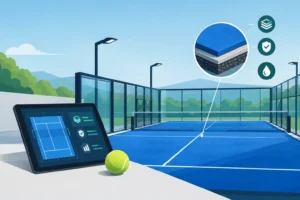
A canopy roof is usually a system rather than one material. The primary covering, structural frame, fixings, gutters, side protection and ventilation strategy must work together. Selecting a premium roof sheet or membrane alone will not compensate for inadequate drainage details or a frame that has not been engineered for local loads.
Architectural PVC membrane
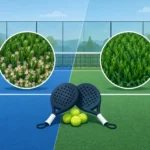
PVC-coated polyester membrane remains a practical option for many padel canopy projects. It offers a competitive balance of weather protection, controlled daylight and large-span coverage. Quality architectural-grade membranes can be tensioned across steel structures to create a clean, modern form with relatively low roof weight compared with rigid alternatives.
The specification is decisive. A low-cost fabric may discolour, lose tension or become difficult to clean sooner than expected. Higher-grade PVC membranes, often finished with protective surface lacquers, are better suited to venues where visual presentation and long service life matter. They can also be supplied in different colours and translucency levels, allowing the project team to manage glare and the external appearance of the facility.
The trade-off is that PVC is not the longest-life option in every environment. It needs correct tensioning, good edge detailing and a realistic maintenance plan. Where the project calls for a landmark structure with maximum longevity, other membrane types may justify their higher capital cost.
PTFE-coated glass fibre membrane
PTFE-coated glass fibre is a premium architectural membrane with exceptional durability, strong resistance to ultraviolet exposure and a high-quality visual finish. It is commonly considered for major leisure schemes, destination clubs and projects where the canopy forms a prominent part of the architecture.
Its translucent character can provide useful natural light without relying on extensive glazing. It also retains its appearance well and has a long expected service life when correctly designed and installed. For investors, that can reduce the risk of an early replacement cycle.
However, PTFE is more expensive, less forgiving during installation and requires specialist fabrication. It is not automatically the best commercial decision for every club. Where a project has a constrained budget, a well-engineered PVC system may deliver the stronger return, particularly if it covers multiple courts and drives immediate utilisation gains.
Polycarbonate and rigid translucent panels
Polycarbonate panels are often considered where a more rigid roof profile is preferred or where maximum daylight is a priority. Multiwall polycarbonate can offer insulation benefits and a lighter weight than traditional glazing, while solid panels can create a crisp, contemporary roofline.
For padel, daylight alone should not dictate the decision. Highly transparent roofing can increase glare, solar gain and ball-tracking issues at certain times of day. A diffused or opal finish is frequently more appropriate than clear panels because it spreads light more evenly across the playing area.
Rigid panels also demand careful attention to expansion, sealing and impact resistance. Water ingress at joints, poorly designed fixings and insufficient allowance for thermal movement can create avoidable maintenance problems. In exposed settings, the supporting structure and panel fixing pattern must be engineered for uplift loads rather than selected from a standard detail.
Metal roof systems
Insulated metal roof panels provide excellent weather resistance, strong acoustic performance and valuable thermal control. They are particularly relevant for fully enclosed or semi-enclosed padel buildings where the operator wants a more conventional sports-hall feel and greater control over the internal environment.
Their limitation is natural light. Without rooflights or carefully planned translucent sections, metal roofing can make courts feel artificial and reliant on daytime lighting. This can be addressed through a mixed roof design, but the junctions between materials need to be detailed properly to protect against leaks and condensation.
For commercial venues in noise-sensitive locations, insulated panels may be attractive because rain noise is typically less pronounced than under lightweight single-skin roofs. That said, acoustics should be assessed across the whole canopy. The impact of play, player voices and surrounding activity will still require consideration where homes or other businesses are nearby.
Daylight, glare and player comfort
A padel court needs consistent visual conditions. A canopy that is bright from the outside can still produce difficult contrast against the ball, especially when direct sun enters through open elevations. The best material is therefore not necessarily the clearest or lightest one. It is the one that creates usable, even light throughout the day.
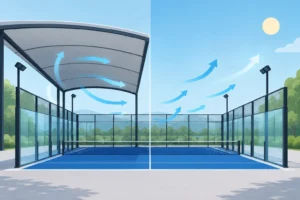
Translucent membranes and diffused polycarbonate can work well when paired with thoughtful orientation and side screening. On east-west court alignments, low morning and afternoon sun may need more control than a roof alone can provide. Shade mesh, louvred side elements or solid end sections can reduce glare while preserving ventilation.
Artificial lighting must be designed as part of this conversation. Roof materials can reflect, absorb or scatter light differently, affecting the number and position of fittings required. A canopy should support clear visibility without creating reflections on glass walls or uncomfortable brightness above the net.
Structural loading and weather exposure cannot be assumed
Every site has its own design conditions. Wind, snow, rainfall intensity, altitude and proximity to the coast all influence material choice and structural calculations. A lightweight membrane roof may look simple, but it transfers significant forces into its frame, foundations and anchor points when exposed to wind.
Drainage deserves equal attention. Standing water can accelerate wear, increase loading and undermine the clean appearance of the canopy. Roof geometry, membrane tension, gutter capacity and downpipe locations must be coordinated before manufacture. Water should be moved away from entrances, court surrounds and spectator areas without creating hazards on busy routes.
Fire performance is another essential specification item. The proposed material should meet applicable fire classifications for the jurisdiction, while the wider design should allow for safe access, emergency procedures and any planning requirements. For projects in the UK, local authority expectations and building-control considerations should be addressed early rather than treated as an installation-stage issue.
Maintenance and whole-life cost
The least expensive material at quotation stage is not always the least expensive over ten or fifteen years. Owners should consider cleaning frequency, access requirements, replacement availability, warranty terms and the cost of business interruption if a roof section needs repair.
Membranes benefit from periodic inspection of tension, seams, fixings and drainage points. Polycarbonate requires cleaning that avoids surface damage and checks around joints. Metal systems need routine attention to coatings, flashings and gutters. These are manageable tasks when planned, but they should be included in the operating budget from the outset.
A premium canopy also protects the perceived value of the club. Stained roof fabric, leaking joints or poor internal light can quickly weaken a facility’s positioning, even when the courts themselves are high quality. Materials should therefore be judged against the standard of customer experience the venue intends to sell.
Make the canopy part of the court investment
The most effective projects treat the canopy, court model and installation programme as one engineered package. This improves coordination between foundations, steelwork, glass clearances, lighting and access, while reducing the risk of late design changes. It also enables a supplier to balance panoramic visibility, structural strength and the visual character of the venue.
For clubs and developers, the decision comes down to matching material performance with the revenue model. A durable PVC membrane may be the right answer for rapid multi-court expansion. PTFE can suit a flagship destination. Insulated metal and mixed-material roofs may be stronger choices where enclosure, acoustics and environmental control carry greater value.
A well-specified canopy should make more playing hours possible without compromising the open, premium feel that attracts players to padel. Working with an experienced manufacturer such as inCourts allows the material, structure and court layout to be evaluated together, so the finished facility performs as confidently as it looks.

No comment yet, add your voice below!