

Padel technology is often discussed in terms of rackets, booking apps and match analysis. For a club owner or developer, the more consequential technology is built into the court itself: the steel structure, glass system, turf, lighting, drainage and weather protection that determine how the asset performs every day.
A padel court is a revenue-generating sports facility, not simply a playing surface with walls. Its technical specification influences player satisfaction, maintenance requirements, available operating hours and the visual standard of the venue. The right decisions at project stage create a court that looks premium at launch and remains dependable under sustained commercial use.
What padel technology means for court investors
At infrastructure level, padel technology is the combination of engineering and materials that makes the game safe, consistent and commercially viable. It includes structural design, connection details, tempered glass, synthetic turf systems, LED lighting, enclosure geometry and, increasingly, canopy solutions.
These elements must work as a system. A striking panoramic court with poor lighting will not deliver the expected playing experience. High-grade turf cannot compensate for an under-specified structure exposed to wind loading. Likewise, a canopy adds value only when its foundations, water management, clear height and ventilation have been properly considered.
This is why the lowest headline court price can be misleading. Decision-makers should compare technical scope, not just the visible outline of a court. Steel thickness, coating process, glass fixing method, lighting layout and installation capability all affect the long-term cost and reputation of the facility.
Structure: the foundation of reliable performance
The steel frame is the core of a padel court. It carries the glass, mesh and lighting equipment while resisting the forces created by wind, ball impact, player contact and repeated use. A premium court should be engineered for its intended environment rather than supplied as a generic structure with limited adaptation.
Structural strength is particularly relevant for exposed sites, rooftop projects and installations in areas with demanding weather conditions. Wind load, ground conditions and local construction requirements can change what is appropriate. A court designed for a sheltered indoor club may need a different approach when installed near the coast or within an open leisure development.
Finish matters as much as strength. A clean, durable powder-coated surface protects the steel while maintaining the visual quality expected by members, guests and commercial partners. Poor coating preparation or weak detailing around joints can lead to premature corrosion, staining and a tired appearance. These are not cosmetic issues alone: they can lead to avoidable maintenance and operational disruption.
Panoramic visibility has an engineering cost
Panoramic and full panoramic courts have become the visual benchmark for premium padel venues. Fewer visible posts create cleaner sightlines, improve the spectator experience and give a club a more distinctive appearance in photography and promotional material.
However, reducing structural interruptions demands careful engineering. Glass panels, steel supports and fixing systems must manage load without compromising stability or visual refinement. Full panoramic design is therefore not simply an aesthetic upgrade. It is a more demanding structural solution, best suited to operators who value a flagship court environment and understand the commercial return of presentation.
For projects where capital efficiency is the priority, a pillar-based model can still provide a strong, professional court solution. The decision should reflect site conditions, target customer, court visibility and the role padel plays within the wider facility.
Glass and enclosure systems: safety without distraction
The glass enclosure defines the padel playing experience. It must offer predictable ball rebound while providing a safe barrier for fast-moving players. Tempered glass is the expected standard, but quality also depends on thickness, edge treatment, drilling accuracy, mounting components and the way panels are supported within the overall frame.
A court’s glass system should be selected with both play and operations in mind. Clear, well-aligned panels present the court at its best and allow coaches, spectators and venue staff to follow play easily. Quality fixings reduce unwanted movement and help preserve the precise, premium appearance that investors expect from a new installation.
The metal mesh sections deserve equal attention. Their geometry, tension and finishing affect ball behaviour, player safety and durability. Rattling panels, poorly finished edges or inconsistent joints quickly undermine an otherwise high-specification installation.
Playing surface technology is about consistency
Turf is one of the first elements players notice, yet it is sometimes specified late in the project. The surface affects traction, comfort, ball speed and the ability of players to change direction with confidence. The best choice depends on expected usage, player profile, maintenance plan and whether the court is indoors or outdoors.
A suitable padel turf system should work with the chosen sand infill and installation method to maintain an even playing surface. Excessive or poorly distributed sand can affect movement and bounce, while insufficient infill may reduce stability and accelerate wear. Regular brushing, cleaning and infill management should be planned from the first day of operation, not treated as an afterthought.
Colour also has a commercial role. Traditional blue courts remain highly recognisable, while green, terracotta and custom options can support a club’s architectural or brand direction. Whatever colour is selected, visual contrast with balls, lines and surrounding finishes should remain clear under the venue’s lighting conditions.
Lighting extends revenue, but layout determines quality
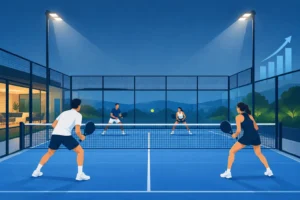
For many facilities, evening play is where the business case becomes strongest. Modern LED systems can reduce energy consumption and maintenance demands compared with older lighting approaches, but the fixture itself is only one part of the equation.
The lighting design must deliver usable, even illumination across the entire court. Dark corners, glare at the net and strong shadows near the glass affect both playability and perceived quality. Pole position, mounting height, beam direction and surrounding light spill need to be considered together.
Outdoor projects may also face planning considerations relating to neighbouring homes, roads or public spaces. A technically appropriate lighting scheme balances player visibility with responsible control of overspill. For a multi-court club, centralised controls and scheduled operation can further support efficient management without compromising the member experience.
Canopy technology changes the operating model
In the UK, a canopy can significantly alter the commercial potential of a padel investment. It protects courts from rain, reduces weather-related cancellations and helps maintain a more consistent playing environment through the year. For operators building demand in a competitive market, dependable court availability can be a clear differentiator.
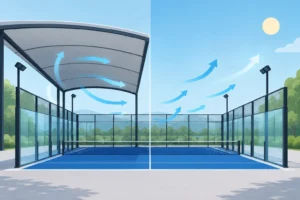
A canopy is not a simple cover placed above a completed court. Clear internal height, ventilation, condensation management, drainage, lighting integration and access for installation all need to be addressed early. The supporting structure must also be compatible with the court layout and the site’s groundworks.
There are trade-offs. A more enclosed solution can offer greater weather protection, but requires careful attention to airflow and acoustic conditions. An open-sided canopy retains a closer connection to the outdoor environment while offering practical protection from rain. The right option depends on local climate, planning constraints, customer expectations and the planned level of year-round use.
Specify for the whole project, not the product brochure
The strongest padel developments begin with a site-led specification. Before selecting a court model, establish the available footprint, access route for materials, ground condition, drainage approach, electrical capacity, planning position and anticipated customer profile. These factors determine whether a visual flagship court, a high-capacity club layout or a weather-protected installation will generate the best return.
A capable manufacturer should be able to translate those requirements into a coordinated project scope, from quotation and production through to installation. This reduces the risk of gaps between the court supplier, civils contractor, electrical team and canopy provider.
At inCourts, this approach supports the selection of panoramic, full panoramic and pillar court solutions according to the technical and commercial requirements of each development. The objective is not to force every project into one model, but to deliver a court environment that performs with confidence in its intended setting.
Build for repeat bookings
Players may arrive because padel is growing rapidly, but they return because the experience feels right. They notice clear glass, even lighting, dependable footing, dry courts and a venue that looks as considered as it plays. For investors, that is where court technology becomes commercial value: in the repeat booking, the stronger membership proposition and the facility that still presents well long after opening day.
Choose the specification with the operating life of the asset in mind. A well-engineered court gives a venue more than a place to play – it gives the business a stronger platform to grow.

No comment yet, add your voice below!