

A rain-affected evening does more than cancel a booking. It disrupts coaching programmes, league fixtures, member confidence and the predictable court utilisation that makes a padel investment perform. So, are padel canopy covers worth it? For many UK clubs and facility operators, the answer is yes – provided the canopy is specified as a long-term infrastructure asset rather than an add-on roof.
A padel canopy protects more than the playing surface. It protects the commercial model behind the court. Yet it also introduces higher capital cost, planning considerations and engineering requirements that need to be assessed before a project is committed.
Are padel canopy covers worth it for your business model?
The strongest case for a canopy is simple: more playable hours create more dependable income. Outdoor padel has substantial appeal, but British weather can make utilisation inconsistent through autumn and winter, and even during summer rainfall can interrupt peak-time sessions. A covered court gives operators a clearer basis for selling memberships, coaching blocks, corporate events and recurring bookings.
The value is particularly clear where demand already exceeds available evening capacity. If rain regularly removes prime-time revenue, a canopy can reduce lost bookings and protect player satisfaction without requiring a fully enclosed building. It can also make a site more attractive to coaches, who need certainty when scheduling junior academies, group sessions and private lessons.
However, a canopy does not automatically make commercial sense on every site. A small club with limited padel demand, restricted operating hours or an uncertain planning position may be better served by establishing utilisation first. Equally, where the principal objective is year-round competition-level operation in a severe climate, an enclosed padel building may offer a more complete solution. The right answer depends on local weather exposure, achievable court rates, utilisation forecasts and the wider facility proposition.
What a canopy changes on court
A quality padel canopy should create a more dependable playing environment while preserving the open character of the sport. It provides protection from rain and reduces disruption from direct sun, allowing players to see the ball more clearly at key times of day. It also helps maintain a drier access route around the court, improving the arrival experience for members and guests.
The playing benefit is not simply about staying dry. Rain on glass, turf and access areas can create operational risk, delay court turnaround and require staff intervention. A properly designed cover helps operators keep the court available, with fewer weather-led closures and a more consistent standard of presentation.
Canopies are not the same as indoor courts
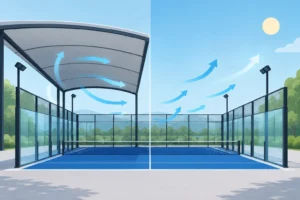
This distinction matters when setting customer expectations. A canopy protects the court from overhead weather, but side-driven rain and wind may still affect play depending on the structure and site orientation. It will not create the fully controlled temperature, acoustic and environmental conditions of an enclosed facility.
For many clubs, that is precisely the attraction. A canopy offers meaningful weather resilience with a lighter visual and financial footprint than a complete building. But it must be designed for the local environment, with appropriate consideration for wind loads, drainage, roof geometry, lighting integration and safe clearance above the playing area.
Engineering determines whether the investment lasts
A canopy is a structural project, not a fabric accessory. Its performance depends on the relationship between the roof structure, foundations, court frame and surrounding ground conditions. Under-specifying any one of these elements can create maintenance exposure and compromise the appearance of the development over time.
Wind is often the defining technical consideration. A large roof surface is subject to significant uplift and lateral forces, particularly on exposed sites. Structural calculations must reflect the project location and applicable standards, while foundations need to suit both the canopy loads and the site’s geotechnical conditions. This is not an area for generic assumptions.
Drainage deserves the same attention. Roof water must be collected and directed away from court entrances, playing areas and neighbouring land. Poor drainage can undermine the very purpose of the cover, leaving puddling around the perimeter and adding avoidable maintenance demands. Integrating gutters, downpipes and a suitable surface-water strategy from the outset is more efficient than trying to solve runoff after installation.
Lighting should also be planned as part of the structure. Players expect even illumination with minimal glare, and operators need practical access for inspection and replacement. A premium canopy installation should look considered in daylight and under floodlights, rather than appearing as a court with equipment added around it.
At inCourts, canopy projects are approached as part of the complete court environment, bringing structural strength, clean finishing and the visual quality expected of a premium padel facility.
The commercial case: calculate protected hours, not just the roof price
The most useful way to assess a canopy is to model the value of protected court hours over its expected life. Start with current or forecast annual utilisation, then identify the hours most likely to be lost to rain, wet surfaces and poor conditions. Apply realistic average revenue per court hour, including casual pay-and-play, member usage, coaching and event activity where relevant.
Avoid assuming that every saved hour becomes paid revenue. Some bookings may move to another slot, and demand is rarely uniform throughout the week. The analysis should focus on peak periods, cancelled coached sessions and the months when weather reliability has the greatest effect on customer behaviour.
A canopy can also support pricing confidence. Players may accept a premium for a covered court, particularly where alternatives are fully exposed and availability is limited. That premium needs to reflect the local market, but predictable playability is a tangible benefit rather than a cosmetic feature.
The return may be strongest when combined with a broader facility strategy. A tennis club adding padel can use covered courts to retain members through wetter months. A hospitality venue can offer bookable activity with less weather risk. A developer can use a high-quality covered padel installation to strengthen the amenity value and visual identity of a scheme.
Planning, neighbours and site design cannot be left until later
The height and visual presence of a canopy can make planning a central project consideration. Requirements vary by local authority, but operators should expect scrutiny around scale, appearance, lighting spill, noise, drainage and impact on neighbouring properties. Early engagement with planning professionals and a clear site plan can prevent expensive redesigns.
A well-designed structure helps the planning case. Clean lines, considered materials and a proportionate relationship to surrounding buildings can make a substantial difference to how the development is received. Positioning is equally important: orienting courts and canopies carefully can reduce glare, preserve access and minimise perceived impact from nearby homes or roads.
Noise should be considered honestly. A canopy may change how ball impacts and player voices travel across a site. This does not make a project unsuitable, but it does mean that proximity to residential boundaries, operating hours and acoustic mitigation should be assessed early. A credible project plan addresses neighbour concerns before they become objections.
Questions to answer before commissioning a padel canopy
Before moving from quotation to installation, decision-makers should be able to answer five practical questions:
- What level of weather protection does the operating model require: covered, partially enclosed or fully indoor?
- How many high-value booking and coaching hours are currently at risk each year?
- Has the site been assessed for wind exposure, ground conditions, drainage and service routes?
- What planning, lighting and neighbour considerations apply to the proposed footprint and height?
- Does the chosen supplier control the engineering, manufacturing and installation quality needed for a single accountable delivery process?
These questions turn a broad product decision into an investable project. They also expose situations where a canopy may not yet be the right first move – for example, when demand validation, planning certainty or ground preparation still needs attention.
Choose a canopy that supports the court’s long-term position
A premium padel court is highly visible. Its structure, glass, turf, lighting and roof all shape how players judge the venue before the first point is played. A canopy should therefore complement the court rather than distract from it. Proportions, finish quality and panoramic sightlines matter, especially for clubs positioning padel as a flagship revenue stream.
The best investment is rarely the cheapest initial structure. It is the solution that delivers dependable operation, credible engineering, manageable maintenance and an appearance that continues to support premium pricing. If protected play will materially improve utilisation and customer confidence, specify the canopy with the same care as the court beneath it – and let the project earn its value every wet week of the year.


No comment yet, add your voice below!