

A padel project can look compelling on paper long before it becomes commercially viable. Padel facility feasibility is the process that tests whether local demand, site conditions, capital requirements and operating capacity can support a profitable, durable venue – not simply whether there is room to install courts.
For club owners, developers and hospitality operators, this distinction matters. A premium court is a long-term capital asset, and the strongest projects combine high-quality infrastructure with a location, operating model and customer proposition designed to keep courts active throughout the week.
What padel facility feasibility should establish
A proper feasibility assessment answers a simple commercial question: can this facility generate sufficient, sustainable income for the level of investment required? The answer depends on more than participation headlines. Padel may be growing rapidly, but demand is local. A successful facility needs a defined catchment, accessible pricing, reliable booking availability and a reason for players to return.
The assessment should establish the likely number of active players, the level of existing and planned competition, realistic court utilisation and the revenue potential beyond court hire. It should also identify constraints that can materially affect cost or programme, including planning conditions, drainage, ground preparation, power supply, access for installation and noise management.
The objective is not to make every opportunity fit. It is to identify the projects where premium courts, professional installation and a clear operating plan create a credible commercial return.
Start with the catchment, not the court count
The question is not simply how many people live nearby. It is whether enough of those people are likely to play regularly, at the times your courts are available, at a price that supports the business.
A strong catchment assessment considers population density, affluence, age profile, local sports participation and travel patterns. In urban areas, players may accept a short journey by public transport or bicycle. In suburban and regional locations, convenient parking and straightforward vehicle access can be decisive. A site beside a gym, tennis club, university or established leisure destination may also benefit from a ready-made audience and shared footfall.
Competitor analysis needs equal care. Existing padel venues do not automatically rule out a project. In fact, they can prove that the market understands the sport. The key is to assess their number of courts, booking availability at peak times, pricing, customer reviews, coaching offer and overall facility quality. A busy but under-supplied market can support a new venue. A market with persistent off-peak availability and heavy discounting demands more caution.
Planned supply must be included as well. New clubs, municipal schemes and conversions within the next 12 to 24 months can alter the revenue forecast before the first ball is played.
Test the site as an operating asset
A padel court footprint is only one part of the space requirement. Circulation, entrances, reception, changing facilities, storage, spectator areas, café space, parking and safe emergency access all influence the site layout and customer experience.
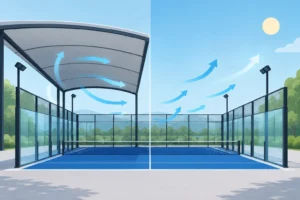
For outdoor developments, the feasibility work should investigate topography, soil conditions, drainage routes, prevailing wind, sunlight, flood risk and the practical route for materials and lifting equipment. An apparently economical plot can become expensive if it requires major retaining works, extensive piling or complex utility upgrades. Early technical review protects the budget and helps avoid design compromises later.
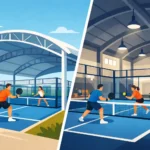
Indoor sites bring different considerations. Clear internal height, column positions, roof loading, fire strategy, ventilation, lighting, acoustics and the condition of the existing slab all need to be assessed. Converting a warehouse can be attractive because weather does not limit play, but the building must genuinely support the proposed use. Heating and energy costs also need to be modelled rather than treated as a secondary issue.
Planning and neighbour impact should be addressed at the earliest stage. Court lighting, evening activity, visual impact and ball noise may require careful mitigation, particularly near residential boundaries. Canopy solutions can extend playing hours and improve weather resilience, but they remain part of the planning and design conversation. A well-considered layout, suitable lighting specification and appropriate acoustic approach are far less costly than retrofitting solutions after objections arise.
Build a realistic revenue model
Court hire is normally the core revenue stream, but the forecast must be based on achievable occupancy rather than headline rates. Peak evening and weekend slots may fill quickly, while weekday daytime demand often takes longer to build. The financial model should therefore separate peak, shoulder and off-peak utilisation instead of applying one average percentage across every opening hour.
Membership can improve retention and cash flow, provided it does not restrict pay-and-play access so heavily that the club loses new customers. Coaching, introductory sessions, leagues, tournaments, corporate events, junior programmes, food and beverage, equipment sales and sponsorship can all strengthen revenue. Their contribution varies widely by location and operator capability, so each should be modelled conservatively.
A useful feasibility model tests at least three cases: cautious, expected and high-performing. The cautious case should assume a slower membership build, lower off-peak occupancy and a longer period before ancillary income reaches maturity. If the project only works under an optimistic utilisation assumption, the investment case needs revisiting.
Pricing also requires discipline. Premium court design and strong finishes can justify a higher market position, particularly where the venue offers panoramic visibility, quality lighting, excellent surfaces and professional programming. Yet a price premium must align with the local customer base. The right strategy is not always to be the cheapest venue; it is to offer a standard of play and service that players recognise as worth returning for.
Account for the full capital requirement
Court purchase and installation are major items, but they are not the full project cost. A credible capital plan includes enabling works, foundations, surfacing, drainage, electrical infrastructure, lighting, fencing, access routes, professional fees, planning costs, contingency, booking technology, furniture and working capital for the launch period.
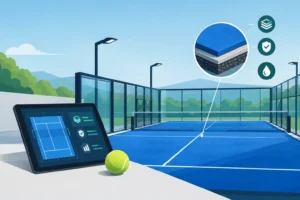
The specification of the court also affects commercial performance. A facility positioned around premium experience may benefit from full panoramic designs that create strong sightlines, an open visual identity and a setting suited to events, content and spectator engagement. A pillar-based model can be the more appropriate choice where budget, site constraints or a multi-court roll-out takes priority. Neither route is inherently better. The right decision follows the business model, target customer and required lifespan of the asset.
Structural quality should not be treated as a cosmetic upgrade. Steel engineering, glass specification, coatings, fixings, turf system and installation accuracy determine how well a court performs under intensive use and changing weather conditions. Lower upfront cost can become a false economy if maintenance, downtime or early replacement affect revenue and reputation.
A sensible contingency is equally important. Ground conditions, utility connections and planning requirements are common sources of cost movement. The earlier these risks are investigated, the more reliable the investment decision becomes.
Design operations before opening day
Many facilities underperform not because the courts are wrong, but because the operating plan begins too late. Staffing structure, coaching partners, booking rules, membership terms, cleaning routines, maintenance responsibilities and launch marketing should be defined during development.
The opening period needs particular attention. Padel converts best when new players can try the sport in a welcoming, organised environment. Introductory coaching, social sessions and local partnerships can turn curiosity into repeat booking behaviour. Regular leagues then create habits, community and predictable demand.
Maintenance planning protects the revenue model. Courts need scheduled inspection of glass, structure, turf, netting, lighting and access points, alongside cleaning that keeps the venue looking premium. Operators should clarify who will provide technical support, what spare parts are available and how quickly issues can be resolved. A court out of service during peak season is not merely a maintenance problem; it is lost income and a poor customer experience.
For multi-site operators and larger developments, standardising court models, finishes and maintenance processes can reduce complexity as the portfolio grows. InCourts supports this approach through manufactured court options and project delivery that connect specification decisions with installation requirements.
Padel facility feasibility is a decision framework
The best feasibility studies are not documents produced to justify a predetermined decision. They are practical decision frameworks that show where value will be created, where risk sits and what must be true for the project to perform.
A strong project may proceed in phases, beginning with a court count that matches proven demand while retaining space for expansion. Another may require a more ambitious launch because its location, hospitality offer or destination status depends on scale. It depends on the market, the site and the operator’s ability to build an active playing community.
Before committing to a final court specification, ensure the commercial plan and physical design are working towards the same outcome. When demand evidence, site engineering, premium construction and day-to-day operations are aligned, a padel facility has a far better chance of becoming a lasting local sports asset rather than a short-lived trend.



No comment yet, add your voice below!