

A commercial padel facility is no longer judged only by the number of courts it can fit onto a site. The future of commercial padel facilities will be defined by how reliably they operate, how well they protect revenue throughout the year, and whether they create an experience players are willing to return to and pay for.
For club owners, developers and operators, that changes the investment conversation. Demand remains an important starting point, but demand alone does not protect a capital asset. The facilities best placed for long-term performance will combine premium court infrastructure, intelligent site planning and a clear operating model from the outset.
Commercial padel facilities will be built for year-round use
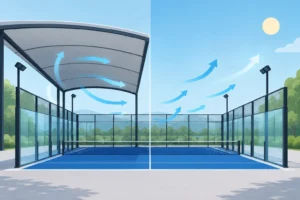
In Great Britain, weather exposure is not a secondary consideration. An uncovered court can look attractive on a site plan, but lost bookings during persistent rain, wind disruption and poor seasonal utilisation can quickly affect the financial model. This is why canopy covers and enclosed or partially protected playing environments are becoming central to commercial padel development.
A well-designed canopy is not simply an add-on placed above a court after opening. It must work with the court structure, lighting layout, drainage, access routes and local planning requirements. Clearance height, airflow and acoustic performance all need consideration. A poor solution can make the court feel dark, loud or restrictive. A properly engineered cover protects playing quality while retaining the open, social character that makes padel commercially appealing.
The right approach depends on the site. A hospitality venue may prioritise visual integration with its existing architecture. A high-volume pay-and-play club may require maximum weather protection and operational resilience. Municipal facilities may need a durable, low-maintenance structure that supports broad community access. In every case, the objective is the same: protect utilisation and make revenue less dependent on the forecast.
The premium experience will move beyond the court
Padel has grown quickly because it is accessible, sociable and easy to organise. However, as more venues enter the market, a court booking alone will not always be enough to distinguish one facility from another. Players will increasingly choose clubs that make the full visit feel considered.
That starts with the playing environment. Clear sightlines, quality glazing, even illumination and a clean finish influence how players perceive a venue before the first ball is played. Panoramic court designs have particular commercial value in flagship settings because they improve visibility for spectators, coaching, events and social content. They also create a stronger first impression for prospective members and corporate clients.
The surrounding environment matters just as much. Reception flow, changing areas, seating, food and beverage, equipment retail and viewing spaces all affect dwell time and secondary spend. A facility does not need to become a luxury destination to perform well, but it should feel intentional. Players notice whether circulation is awkward, whether court access is congested and whether there is somewhere comfortable to stay after a match.
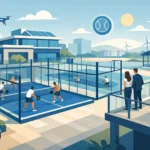
For developers, this has a practical implication: do not design padel as an isolated box of courts. Plan it as an active destination with the capacity to host coaching, leagues, social play and private events.
Court selection will become a commercial decision
The strongest facilities will match court specification to their business model rather than defaulting to a single solution across every location. A premium club in a high-visibility urban location may benefit from Full Panoramic Premium courts, where minimal structural interruption creates a clean, professional appearance and superior spectator viewing. This can be particularly valuable for tournaments, exhibition matches and brand partnerships.
A multi-court operator may choose a mix of models. Panoramic courts can anchor the main show court or central area, while high-quality Pilar courts can provide a commercially efficient solution for additional playing capacity. That balance can protect initial capital expenditure without compromising the structural quality or consistent visual standard expected across the venue.
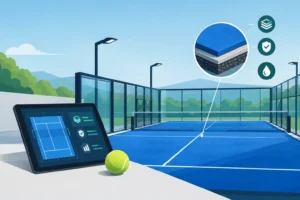
The crucial point is that a court is not a short-term furnishing. It is a core revenue-producing asset exposed to frequent impact, changing temperatures, moisture and intensive daily use. Structural steel quality, galvanisation, coating systems, glass specification, mesh, turf and fixing details all influence maintenance requirements and long-term presentation.
Low initial cost can be attractive when a project is under pressure to open quickly. Yet savings made on the visible structure or engineering details may reappear later through downtime, remedial work, dissatisfied players or a venue that loses its premium appearance too soon. A serious procurement process should assess whole-life value, not only the price per court.
Smarter layouts will protect revenue and operations
More courts do not automatically mean a better facility. A dense layout may appear efficient, but it can create pinch points at entrances, compromise emergency access, limit maintenance space and reduce the quality of the player experience. It may also leave little flexibility for future covers, spectator zones or service infrastructure.
The most effective layouts recognise the different ways courts earn revenue. Peak-hour pay-and-play bookings require quick turnover and simple access. Coaching needs clear gathering areas and room for instructors to work. Leagues and events need spectator capacity, score display positions and a practical route for participants. Corporate sessions often need an area for briefing, hospitality or informal networking.
Lighting deserves the same early attention. Uniform illumination is essential for ball visibility and safety, while energy consumption and glare control affect both operating costs and neighbour relations. Drainage, electrical capacity, equipment storage and cleaning access are less glamorous subjects, but they determine whether a site functions efficiently after launch.
Planning for expansion is equally valuable. A site may begin with four courts, then prove demand for six or eight. Reserving space, utilities and access for a future phase can be significantly less expensive than redesigning an operating venue later. This is where experienced infrastructure planning adds value: it anticipates the operational questions that become expensive once concrete has been poured.
Data will sharpen the operating model
The next generation of operators will manage courts with more precision. Booking patterns can show which sessions attract beginners, which membership tiers convert best and where price sensitivity appears. Attendance data can reveal whether a new league is building loyalty or simply replacing casual bookings that were already likely to sell.
This should not lead to a purely automated club experience. Padel remains a social sport, and human hosts, coaches and community managers remain commercially important. But data can help operators make better decisions about programming, staffing and investment.
For example, a venue with weak weekday daytime utilisation may need targeted coaching programmes, school partnerships or corporate packages rather than broad discounting. A club that regularly reaches capacity in the evenings may need to assess whether extending opening hours, improving weather protection or adding courts offers the strongest return. The answer will vary by location, but the decision should be grounded in real usage rather than assumption.
The future of commercial padel facilities is more selective
The market will continue to reward well-conceived projects, but not every padel proposal will succeed simply because the sport is growing. Competition will make location, access, court quality and operational discipline more important. Facilities with poor visibility, limited parking, weak weather resilience or no clear customer proposition may struggle even in areas with strong participation.
That is not a reason to hesitate. It is a reason to develop with greater discipline. Investors should test demand honestly, understand local supply, model realistic utilisation and choose partners capable of delivering infrastructure that supports the intended positioning. A premium venue requires premium execution. A value-led community venue still requires durability, safety and dependable installation.
Manufacturers have a central role in this shift. The right partner should be able to advise on court configuration, structural requirements and installation realities, not simply supply a standard product. At inCourts, the focus is on combining engineered strength, refined finishes and court models suited to different commercial ambitions, from visually striking panoramic environments to efficient, high-quality multi-court developments.
The most valuable decision is not to ask how quickly a court can be installed. It is to ask what the facility should still be delivering five and ten years after opening: consistent play, a strong visual identity, protected revenue and enough flexibility to grow with its community.





No comment yet, add your voice below!