

A wet Wednesday evening can expose the difference between a promising padel investment and a dependable trading asset. The decision between a padel canopy or indoor hall is not simply about keeping courts dry. It determines how consistently a club can sell court time, how the venue looks, what approvals may be required and how the project performs over its full operating life.
For club owners, developers and leisure operators, the right answer depends on local climate, available land, planning constraints, customer expectations and the commercial role padel will play within the wider facility. Both solutions can protect revenue. Their value lies in choosing the structure that fits the site and business model rather than selecting the largest building or the lowest initial price.
Start with the operating model
Before comparing steelwork, membranes or wall systems, define the venue’s target programme. A club relying on evening peak-time bookings needs protection precisely when weather disruption is most damaging. A hospitality destination may place greater value on an open, light-filled playing environment that complements outdoor amenities. A municipal facility may need a durable solution with controlled access and predictable year-round community programming.
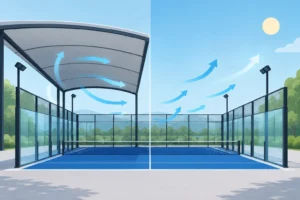
A canopy is often the stronger commercial fit where courts should remain visibly connected to the outdoor setting. It provides overhead weather protection while preserving an open-sided feel, natural ventilation and a lower visual mass than a fully enclosed building. For existing tennis clubs adding padel, this can be a practical way to extend usable playing hours without changing the character of the site completely.
An indoor hall is better suited to operators who require the highest level of environmental control. It protects players from rain, wind and low winter temperatures, while allowing lighting, acoustics, access and ancillary spaces to be planned as a single facility. Where padel is expected to operate as a core, all-weather revenue centre, enclosure can strengthen the proposition.
Padel canopy or indoor hall: the commercial difference
The key difference is not whether either structure can generate income. It is the degree of certainty each gives the operator.
A well-designed padel canopy can significantly reduce weather cancellations and make the programme more dependable across the year. It can also create a premium covered experience without the capital requirement, build complexity and visual impact of a complete hall. For sites in areas with moderate conditions, or venues with an established outdoor sports identity, that balance can be highly attractive.
However, a canopy does not remove every weather variable. Driving rain, strong side winds and cold conditions can still affect player comfort, depending on the orientation, local exposure and degree of side protection. Operators should avoid presenting a covered court as identical to a climate-controlled indoor court. Expectations must match the structure.
A purpose-designed indoor hall offers greater booking reliability in difficult weather and creates a consistent playing environment. This can support higher utilisation, coaching academies, leagues, corporate events and membership packages that promise dependable access. It may also broaden the audience by making the venue more appealing to players who are less willing to play in cold or exposed conditions.
The trade-off is a larger upfront commitment. A hall demands more extensive foundations, building services, planning consideration and coordination with fire, ventilation, insulation and access requirements. It is an infrastructure project, not simply a court cover.
Capital cost should not be assessed in isolation
The headline price of a canopy will usually be lower than a fully enclosed hall, but project decisions should be based on whole-life commercial value. A lower initial investment can be the right choice when it brings courts to market quickly, protects the most valuable hours and leaves capital available for reception upgrades, changing facilities, lighting or additional courts.
Conversely, an indoor hall can justify its cost where the local market supports premium pricing and high annual occupancy. The relevant question is not, “Which structure costs less?” It is, “What level of protected, sellable court time will this location support over the next ten to fifteen years?”
Build a forecast around realistic utilisation, not optimistic demand assumptions. Model peak and off-peak rates, coaching income, competitions, memberships and maintenance provision. Then stress-test the forecast against poor weather, energy costs, financing terms and the possibility of new local competition. The stronger structure is the one that keeps the project viable under those conditions.
Account for the full project scope
Structural cover is only one line in the budget. Ground conditions, drainage, electrical supply, lighting, access routes, crane operations, surveys and local authority requirements can alter the cost substantially. An indoor hall may additionally require heating strategy, ventilation, internal finishes, fire systems and building-control compliance.
Canopy projects also need careful engineering. Wind loads, snow loads, guttering, rainwater management and column placement must be resolved around safe play and unobstructed circulation. A visually clean canopy that has not been engineered for local conditions is not a premium asset.
For this reason, project partners should provide a clear scope from quotation through manufacturing and installation. Early technical coordination reduces late-stage variations and protects the programme.
Player experience and court presentation
Padel is highly social and highly visible. The structure above the court therefore becomes part of the customer experience and the venue’s commercial identity.
A canopy can create an impressive semi-outdoor environment. Daylight remains strong, air moves naturally and the courts retain a direct relationship with terraces, viewing areas and the surrounding club. With appropriate lighting and a refined structural design, covered courts can look purposeful rather than temporary. This makes canopies particularly effective for clubs seeking premium protection without losing the atmosphere of outdoor play.
A hall provides a different form of quality: consistency. Players benefit from reduced wind, stable lighting and greater comfort across the seasons. Ceiling height is critical. Padel involves lobs, defensive recovery and high trajectories, so the building envelope must allow the game to be played properly rather than forcing compromises around roof structure, fittings or services.
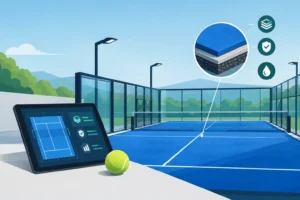
In either case, the court itself should match the standard of the cover. Strong steel construction, reliable glass systems, quality turf, professional lighting and clean finishes reinforce confidence in the venue. A flagship Full Panoramic court can create exceptional visual impact in a premium destination, while a Pilar model may offer a more measured route to high-quality capacity. The structural solution and court model should be selected together, not as separate purchases.
Site conditions can decide the answer
Some projects are effectively decided by the site before commercial preference enters the discussion. Available footprint, boundary distances, height limits, access for installation equipment and neighbouring properties all influence what can be delivered.
A canopy can be advantageous where planning authorities are sensitive to building bulk or where a club needs a lighter visual intervention. Open sides may reduce the perceived mass, although the exact planning outcome will depend on the location and authority. Orientation is equally important: positioning should limit prevailing wind and driving rain while preventing glare at key playing times.
An indoor hall requires more detailed consideration of scale, elevations and surrounding impact. It may be appropriate for an industrial, urban or larger leisure setting where enclosed sports buildings are already established. On constrained sites, the hall can also consolidate operations efficiently, particularly if reception, changing facilities or spectator space are integrated into the project.
Do not treat drainage as an afterthought. A canopy concentrates rainwater at defined collection points, and a hall changes the site’s drainage profile too. Effective water management protects foundations, walkways and neighbouring land while keeping the arrival experience professional during heavy rain.
Engineering quality protects availability
Whether open-sided or enclosed, the cover must be designed as a long-term sports structure. The engineering needs to reflect the project’s geographic location, exposure category and applicable loading requirements. This is where generic, lightly specified products can create avoidable risk.
Material finish matters as much as raw strength. Corrosion protection, connection detailing, roof tensioning or cladding interfaces, lighting integration and future maintenance access affect both appearance and operating reliability. The best structures make their technical discipline visible through clean lines, stable performance and a finish that continues to represent the venue well after opening.
Installation experience matters too. Court construction, cover installation and final commissioning must be coordinated so that glass, turf, lighting and steelwork are protected throughout the programme. A single accountable infrastructure partner can reduce handover gaps between trades. inCourts approaches these projects with that manufacturer-led focus, combining court design, engineered structures and professional installation planning.
Make the decision with a phased-growth view
A canopy is often a sensible first phase for an operator proving demand or upgrading an established outdoor offer. It protects valuable court inventory, supports a premium booking proposition and can allow the business to build a stronger trading record before committing to a larger enclosed development.
An indoor hall may be the right first move when the business case already depends on year-round certainty, high-volume programming and a destination-standard facility. Delaying enclosure in that scenario can mean accepting avoidable cancellations, weaker winter demand and a player experience that falls short of the intended market position.
The strongest projects do not choose a padel canopy or indoor hall by default. They match structural ambition to local demand, site realities and the revenue model behind the courts. When those elements align, the cover does more than shield the playing area – it gives the operator a more credible, more sellable padel business every day of the year.



No comment yet, add your voice below!