

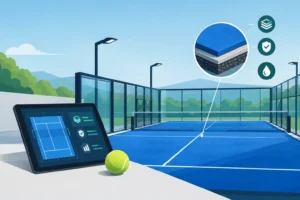
A padel court is not simply a playing surface with glass walls. For a club, developer or hospitality operator, it is a revenue-generating asset expected to carry intensive use, present well from day one and retain its value over many seasons. This premium court specification guide sets out what decision-makers should assess before approving a court package, from steel engineering and panoramic visibility to foundations, lighting and weather protection.
The right specification is rarely the cheapest one on a quotation. It is the one that fits the site, commercial position and expected level of play while protecting the investment against wear, weather and operational disruption.
Start with the commercial brief
Court specification should begin with the operating model, not a product brochure. A premium private club may prioritise visual impact, player experience and the ability to charge higher booking rates. A municipal facility may place greater weight on resilience, straightforward maintenance and efficient use of public capital. A property developer may need a court that complements a wider architectural scheme and can be delivered to a fixed programme.
This brief shapes every subsequent choice. The number of courts, site access, local planning conditions, anticipated player volume and whether play will continue through winter all influence the right solution. A flagship show court can attract members and corporate events, but it should not compromise circulation, spectator areas or the practical needs of a busy venue.
For many new operators, the strongest approach is to combine a visually distinctive premium court with a consistent, durable specification across the rest of the development. This creates a clear focal point without allowing capital cost to outrun the business plan.
The premium court specification guide: structural priorities
The steel structure is the working backbone of a padel court. It carries the glass, mesh and lighting elements while absorbing repeated ball impact, player contact and environmental loading. Its quality is not judged by appearance alone. Engineering, material selection, welding quality, corrosion protection and connection design all matter.
A premium specification should be designed for the project location and intended installation environment. Outdoor sites face wind, rain, temperature variation and corrosion risk. Coastal locations, in particular, demand close attention to protective finishes and maintenance planning. Indoor installations may avoid direct weather exposure, but still require a precise structural design that works with the building, roof height and existing floor construction.
Ask how the court has been engineered, not merely what it looks like. A clean, refined finish should sit alongside structural strength. Powder-coated steelwork can provide a high-quality visual result, but preparation and coating quality determine how well that finish performs over time. The supplier should also be able to explain how the frame, glass supports and anchor points work as one system.
Foundations and site preparation
Even an excellent court structure can be undermined by inadequate groundwork. The slab must be level, stable and correctly prepared for the selected court and local ground conditions. Drainage is equally important outdoors. Water that remains around the perimeter or beneath the playing area can create maintenance issues, affect the surrounding surface and reduce the quality of the customer experience.
Early site assessment avoids expensive changes later. Check access for delivery vehicles and lifting equipment, underground services, finished ground levels, drainage routes and available space around the court. These details are particularly relevant when converting existing tennis facilities or fitting courts into constrained urban sites.
Choose visibility without sacrificing strength
Panoramic design has become a defining feature of premium padel. Reduced corner posts and cleaner glass lines improve views for players, spectators and cameras. For clubs that rely on social content, events or coaching visibility, this can be a direct commercial advantage rather than a purely aesthetic decision.
There is, however, a difference between a court that appears minimal and a court engineered to remain stable with a minimal visual footprint. Full panoramic configurations require careful structural design to preserve rigidity and secure glass alignment. The frame must support the open visual effect without creating avoidable movement or compromising long-term performance.
A Panoramic Premium court can be a strong choice where clubs want high-end presentation with a balanced structural format. A Full Panoramic Premium model is better suited to venues seeking maximum visual clarity and a flagship professional-style environment. Pilar designs may be appropriate where a more conventional post-led structure meets the budget, operating model or site conditions while retaining a quality finish.
The decision depends on the role of the court within the venue. A competition court, hotel centrepiece or front-of-house installation often justifies greater emphasis on panoramic presentation. High-volume community venues may balance this with standardisation and lifecycle efficiency.
Glass, mesh and player safety
Glass is a core playing element, not decorative cladding. Its quality, thickness, fitment and edge protection affect ball rebound, player confidence and the court’s finished appearance. A premium installation should use toughened safety glass suited to padel use and installed with carefully designed supports and fixings.
The mesh sections must also perform consistently. They should be accurately tensioned, securely fixed and finished to resist wear. Poorly aligned panels, rough fixings or inconsistent transitions between glass and mesh can affect both safety and the impression a facility gives to members.
Inspection access should be considered during specification, especially for venues operating long hours. Components will require periodic checks, and a well-designed court makes routine maintenance more practical. This is one area where an apparently lower initial price can become more costly over the life of the asset.
Turf and lighting determine daily playing quality
Players remember how a court feels underfoot and how clearly they can track the ball. Turf should therefore be selected for padel-specific use, with the right pile characteristics, infill approach and installation quality to support movement, comfort and ball response. The preferred system may vary according to indoor or outdoor use, expected booking density and maintenance capability.
Do not treat the turf as a late-stage finish. It needs to work with the base, drainage design and court perimeter. Correct installation and ongoing grooming help maintain an even surface and extend service life.
Lighting has an equally direct impact on revenue. If evening play is central to the business model, lighting design must provide consistent illumination across the full court, manage glare and respect local considerations such as neighbouring properties. The column arrangement, fixture quality and electrical provision should be planned alongside the court structure, rather than added after foundations and steelwork are already fixed.
For facilities with several courts, lighting control zones can help operators balance player experience with energy management. The correct approach depends on opening hours, booking patterns and whether the venue hosts coaching, leagues or competitions.
Canopies turn seasonality into capacity
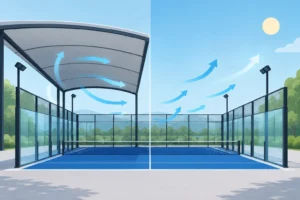
In the UK, weather protection can materially change the economics of a padel development. A canopy supports more reliable bookings, protects the playing environment and gives customers confidence that a reservation will go ahead. It can also improve comfort by managing direct rain and reducing the operational disruption that comes with wet surfaces.
A canopy is not an accessory to be considered in isolation. Its design must account for wind, drainage, clear height, lighting integration, site boundaries and the court layout beneath it. The relationship between the canopy and court structure should be resolved early, particularly where multiple courts are covered in one scheme.
Fully enclosed buildings, lightweight covers and purpose-designed canopies each have different cost, planning and operational implications. There is no universal answer. The appropriate route depends on the site, local authority requirements, budget and the degree of year-round certainty the business needs.
Evaluate delivery capability, not just the court
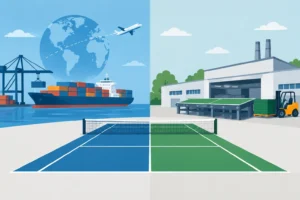
A premium court project involves design coordination, manufacturing, logistics, installation and handover. The supplier’s ability to manage these stages has a significant effect on programme certainty and final quality. This matters most when a development has a launch deadline, multiple stakeholders or an international delivery requirement.
Before appointing a manufacturer, establish who is responsible for each part of the project and how site readiness will be verified. Clarify manufacturing lead times, delivery sequencing, installation scope, quality checks and the process for resolving issues after handover. A court is a long-term infrastructure decision, so the relationship should not end when the installation team leaves site.
At inCourts, the value of an in-house manufacturing and installation-led approach lies in maintaining control over the structural, visual and practical details that define a premium padel environment.
A specification that supports the business case
The most effective court specification connects playing performance with commercial purpose. It considers how the court will look in sales material, how it will withstand peak-time use, how it will operate in poor weather and how it will support the venue’s pricing position.
Before final approval, decision-makers should be able to answer four practical questions:
- Is the structure engineered and finished for this site and its environmental conditions?
- Does the chosen court model match the venue’s target customer and visual standard?
- Have foundations, drainage, lighting and canopy requirements been coordinated from the outset?
- Can the supplier deliver, install and support the project with clear accountability?
A premium padel court earns its place through reliable play, enduring presentation and operational confidence. Specify with those outcomes in mind, and the court becomes more than an addition to the facility: it becomes a credible foundation for sustained growth.



No comment yet, add your voice below!