

A court can have premium steelwork, panoramic glass and high-performance turf, yet still disappoint members after heavy rain. Does padel court drainage matter? For any outdoor facility, it is a fundamental part of court performance, operational reliability and asset protection.
For club owners, developers and operators, drainage is not an invisible technical detail to leave until the end of a project. It directly affects how often the court can be played, how the surface wears, how safely players move and how confidently the facility can trade through wetter periods. A padel court is a revenue-generating installation. Standing water and repeated closures work against that investment.
Why padel court drainage matters
Padel is played on artificial turf filled with sand, set within a precise steel and glass structure. The playing surface must shed water efficiently without losing its evenness or creating areas where moisture remains trapped. When water cannot move through and away from the court system, the immediate result is obvious: puddles, slippery patches and cancelled bookings.
The longer-term effects are more costly. Persistent saturation can disturb the sand distribution within the turf, accelerate surface wear and encourage contamination from fine sediment and organic material. Water held around the perimeter can also place unnecessary pressure on surrounding paving, foundations and drainage channels. None of these issues reflects the standard expected from a premium sports facility.
Drainage also shapes the customer experience. Players will accept that extreme weather affects outdoor sport, but they expect a professionally built court to recover quickly after ordinary rainfall. A court that remains playable sooner can protect peak-time booking income and strengthen a club’s reputation for quality.
The drainage system starts below the turf
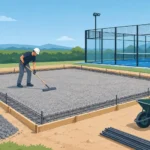
Effective drainage is a complete construction approach, not simply a channel placed at the edge of the court. The finished playing surface, base formation, sub-base, falls, perimeter collection and connection to an approved discharge point must work together.
A correctly prepared base provides stable support and allows water to pass through the intended layers. Its levels need to be controlled carefully. Even a visually minor low point can become a recurring puddle once the court is in use. The aim is not to create a visibly sloped playing area, but to deliver sufficiently accurate falls so that water moves as designed while the court retains a consistent playing feel.
Below this, the chosen aggregate layers must be appropriate for both drainage and load-bearing performance. Padel courts experience concentrated loads at posts, structural supports and access points, as well as repeated dynamic loading from players. A base designed only to move water, without proper compaction and structural capacity, is not an adequate solution.
At the perimeter, drainage channels or other collection arrangements manage water leaving the court surface and the surrounding area. These must be sized and positioned for the site conditions, then kept clear throughout the life of the installation. The final element is discharge. Water needs somewhere lawful and practical to go, whether that is an existing surface-water network, an attenuation solution or another site-specific arrangement agreed during project planning.
Site conditions decide the right solution
There is no universal drainage specification for every padel project. A court in a sheltered urban location with free-draining ground faces different demands from a coastal club exposed to wind-driven rain, or a development built on heavy clay soil. Rainfall intensity, local ground conditions, ground levels and available outfalls all influence the drainage design.
The surrounding hardstanding matters as well. If paths, terraces or adjacent courts direct water towards the padel court, the system has to handle more than rainfall falling directly on the turf. Conversely, a well-designed external area can help keep sediment, leaves and run-off away from the playing surface.
A proper site assessment should establish existing levels, soil behaviour, utility locations and drainage routes before finalising the court position. It is usually far more economical to resolve these constraints at the design stage than to excavate finished works after a wet-season problem appears.
For developers, this has a commercial implication. Selecting a court location simply because it is an available flat area can create avoidable groundworks costs later. The most attractive location for footfall or visibility may still be right, but it should be supported by a realistic allowance for drainage and civil works.
Canopy covers change the water strategy
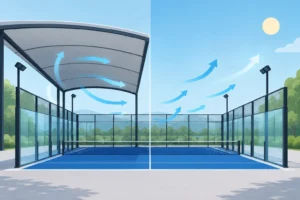
A padel canopy can extend playing hours and protect customers from rain and strong sun, but it does not remove the need for drainage. It changes the pattern of water management.
Instead of rain falling evenly across the court, a canopy collects rainfall over a much larger roof area and directs it to defined outlets. That concentrated roof run-off must be planned into the wider drainage design. Gutters, downpipes, channel capacity and discharge routes all need sufficient capacity for local rainfall conditions.
The benefit is significant: the playing surface receives far less direct rainfall, supporting consistent availability and reducing weather-related disruption. However, water still reaches the court area through wind, open sides, cleaning and surrounding surfaces. A canopy should therefore be considered alongside, not instead of, a high-quality court base and perimeter drainage arrangement.
For covered facilities, the coordination between canopy engineering, court structure and civils is particularly valuable. Clear responsibility across the project reduces clashes between foundations, downpipes, access routes and drainage channels, while preserving the clean visual finish expected from a premium installation.
What poor drainage costs a padel business
The cost of inadequate drainage is rarely limited to one repair visit. It appears through lost court hours, member complaints, increased cleaning, premature turf intervention and disruption to programming. Coaches lose sessions, leagues become harder to schedule and new players can form an unfavourable first impression of the venue.
There is also a safety consideration. Wet artificial turf can alter footing and ball behaviour. Standing water near entrances or around the exterior of the court can create slip risks for players, spectators and staff. Facilities should not rely on temporary fixes such as sweeping water away after each shower. If the same areas flood repeatedly, the underlying cause should be investigated.
That said, drainage investment should be proportionate. Not every site requires extensive below-ground infrastructure, and overspecifying a solution without understanding local conditions can add cost without improving performance. The objective is a design that is technically sound, maintainable and suited to the site’s use, weather exposure and development plan.
Maintenance protects the original performance
Even a well-designed drainage system needs routine attention. Turf should be brushed and maintained so that sand remains distributed correctly and surface permeability is not compromised. Leaves, litter and sediment should be removed from channels and grates before they obstruct water flow.
Facility teams should inspect the court after significant rainfall, particularly during the first season of operation. This reveals whether water is collecting in unusual locations, whether external areas are directing run-off towards the court, and whether channels need cleaning more often than expected. Early intervention is simpler than allowing a minor issue to affect the surface or base over time.
Maintenance is also an opportunity to protect presentation. Clean drainage details, tidy perimeter finishes and a dry entrance area reinforce the standard of the facility. For clubs competing for premium bookings, these details contribute to the overall perception of value.
Plan drainage as part of the court investment
The strongest padel developments treat drainage, foundations, court design and optional coverage as one coordinated package. This approach supports accurate budgeting, smoother installation and a better-performing asset from opening day.
At inCourts, premium court engineering is considered alongside the practical conditions that determine how a facility performs in real use. Whether the project requires a visually striking panoramic court, a durable club installation or a covered padel environment, drainage planning should be addressed before production and installation are scheduled.
A padel court should look exceptional on opening day, but its real value is proven after sustained use and difficult weather. Build the water-management strategy into the project early, and the court has a far better chance of staying safe, presentable and bookable when your customers want to play.


No comment yet, add your voice below!