

A new court can become a high-performing revenue asset, or an expensive operational problem hidden behind attractive glass. Knowing how to procure sports courts means looking beyond the initial quotation. For padel clubs, leisure operators, developers and hospitality groups, the decision must account for ground conditions, structural design, player experience, delivery capability and the commercial role each court will play from day one.
The strongest projects begin with a clear brief and a manufacturer capable of carrying that brief through engineering, production and installation. Price matters, but it is only one part of the capital decision. A court that looks premium, performs consistently and remains serviceable under regular use protects both utilisation and the reputation of the venue.
How to procure sports courts with a commercial brief
Start by defining what the court needs to achieve for the business. A private members’ club may prioritise a refined visual finish and a flagship playing environment. A high-volume pay-to-play venue may need a repeatable court specification that supports rapid expansion and efficient maintenance. A hotel or residential development may be more constrained by planning, noise, access or the visual impact of the structure.
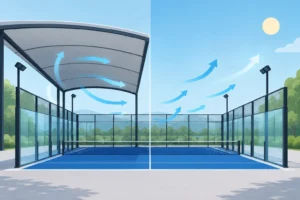
For padel, assess expected demand, operating hours, coaching programmes, tournaments and peak-time capacity before selecting a model. These decisions affect the number of courts, circulation space, reception requirements, lighting strategy and whether a canopy is commercially justified. Covered courts can extend usable playing hours and reduce weather-related cancellations, but they require careful structural coordination, drainage planning and appropriate foundations.
The brief should also distinguish between essential requirements and desirable upgrades. Panoramic visibility, premium turf, upgraded lighting, bespoke colours and canopy systems can all add value. Their value depends on the venue position and the return the operator expects, rather than on specification alone.
Verify the site before selecting the court
A court supplier should not be asked to solve an undefined site. Early site information reduces programme risk, avoids late variations and enables accurate foundation design. The proposed area must be measured not only for the court footprint but also for access, maintenance, emergency routes, player circulation and construction equipment.
Ground conditions are particularly significant. The slab or foundation system must suit the soil, local climate, drainage requirements and structural loads of the court and any canopy. An apparently level hardstanding may still require substantial preparation before it can support a precision sports structure. Obtain relevant surveys early, particularly where the site has made ground, poor drainage, slopes or known services.
Planning and local approvals should be considered at the same stage. Height, floodlighting, noise, canopy coverage and operating hours can all affect consent requirements. For indoor conversions, confirm clear internal height, building access, fire requirements, ventilation and the capacity of the existing floor. Do not assume that a vacant warehouse or tennis court can accept padel infrastructure without technical review.
Access is part of the procurement decision
Manufacturing quality has limited value if delivery and installation have not been planned around site access. Check lorry entry, unloading space, crane requirements, storage areas and the route from the unloading point to each court location. Tight urban sites, rooftop schemes and live leisure facilities often need phased installation and a more detailed logistics plan.
A supplier that asks detailed questions about access, groundworks and sequencing is protecting the project, not complicating it.
Specify the structure, not only the appearance
Padel courts are exposed to repeated ball impact, player contact, weather and the movement created by active play. The glass, steelwork, mesh, fixings, turf and lighting must perform as one system. Procurement should therefore compare the engineering behind each proposal, not simply the images in a brochure.
Ask how the steel structure is designed, protected and finished. Review glass thickness and treatment, mesh construction, welding quality, anchoring details and the approach to tolerances during installation. Premium powder-coating and clean detailing improve the court’s visual presence, but they also need to be supported by durable material selection and controlled manufacture.
Court design should match the venue’s positioning. A full panoramic model can create a striking centrepiece, improve spectator sightlines and reinforce a premium club identity. A panoramic court with structural pillars can offer a high-quality, commercially effective option where budget discipline is more important than maximum visual openness. Neither choice is automatically correct. The question is whether the court model supports the customer experience and investment case.
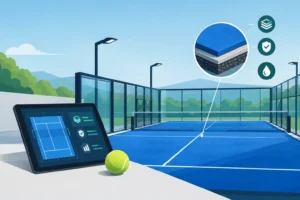
Turf and lighting deserve the same level of scrutiny. The playing surface should provide consistent ball response, secure footing and suitability for the expected intensity of use. Lighting must be designed for playability, glare control, energy consumption and the surrounding environment. Poorly positioned luminaires can undermine an otherwise excellent court.
Compare quotations on scope and risk
A low headline figure is not a meaningful comparison if the scope is unclear. Request itemised proposals that state precisely what is included, from structural components and glass to turf, lighting, freight, installation, foundations, electrical works and canopy interfaces.
There are four areas that should be clear before placing an order:
- the exact court model, finishes, performance specification and approved drawings;
- responsibility for surveys, civil works, drainage, electrical supply and permits;
- delivery terms, installation programme, site responsibilities and commissioning process;
- warranty coverage, maintenance expectations, spare-part availability and after-sales support.
Clarifying these points prevents the common gap between a court purchase and a completed, operational facility. It also makes budget approval more credible for investors, boards and development partners. Include contingency for site works and local requirements rather than treating the court structure as the entire project cost.
Assess the manufacturer behind the proposal
Sports court procurement is a long-term supplier decision. Evaluate whether the manufacturer controls its production, understands structural engineering and has proven installation capability. A project partner should be able to explain the system, provide technical documentation, coordinate with contractors and respond decisively when site conditions require adjustment.
Experience across different markets is valuable, but the relevant question is whether that experience translates into a disciplined delivery process for your site. Review manufacturing lead times, quality controls, project management responsibilities and installation team expertise. Ask who will be accountable from approved quotation through handover.
For an investment-grade padel project, choose a supplier whose product range supports the commercial brief rather than forcing the site into a single standard solution. inCourts combines premium panoramic, full panoramic and pillar court options with engineered canopy solutions, allowing operators to balance visual impact, structural strength and capital priorities.
Plan handover before installation begins
The project is not complete when the final pane of glass is fitted. Handover should include inspection of the playing surface, glass alignment, fixings, gates, lighting and any canopy elements. The operator should understand cleaning requirements, turf care, routine checks and the process for reporting damage or obtaining replacement parts.
Arrange practical acceptance criteria in advance. This is especially useful where several contractors are involved, because it separates supplier responsibilities from those of the groundworks, electrical or building teams. A planned inspection after the first period of operation can also identify minor adjustments before they affect player experience.
The best court procurement decisions are not driven by the cheapest structure or the fastest promise. They are built around a site-ready brief, transparent scope and a manufacturer prepared to stand behind the finished asset. Choose the court your venue will still be proud to present after thousands of matches, not merely on installation day.

No comment yet, add your voice below!