

A padel court can generate strong, repeatable revenue, but only when the funding structure reflects the realities of the site, local demand and operating model. The question of how to finance padel court investment is not simply about finding capital. It is about building a scheme that can carry its debt, protect cash flow and deliver an asset worth operating for years.
For club owners, developers and hospitality operators, the strongest projects begin with a commercial plan before a finance application. Lenders and investors will fund a credible opportunity. They will not fund a court specification alone.
Start with the full project cost, not the court price
A common mistake is to budget for the padel court structure and treat everything else as a secondary expense. In reality, groundworks, drainage, electrical supply, access, lighting, planning, fencing, professional fees and contingency can materially change the required capital. Indoor or covered schemes also require careful assessment of canopy design, foundations, wind loading and site conditions.
Your initial investment model should separate three areas: capital expenditure, pre-opening costs and working capital. Capital expenditure includes the physical build and installation. Pre-opening costs cover planning, legal advice, marketing, booking systems, recruitment and initial stock where relevant. Working capital is the cash reserve that supports the business while utilisation builds.
This distinction matters because a lender may be comfortable financing durable physical assets over several years but less willing to fund launch marketing or early operating losses. Those elements may need to come from equity, retained cash or a separate facility.
A realistic contingency is equally important. Ground conditions, utility upgrades and planning requirements can create costs that do not appear in an early quotation. A project with no contingency is not a lean project. It is a project with an unpriced risk.
Build a lender-ready revenue case
Padel demand is growing, but finance providers will still assess the individual location rather than the sport’s wider momentum. Your business case needs to show why players will choose your venue, how often courts will be used and what happens during quieter periods.
Start with court capacity. Model peak and off-peak occupancy separately, rather than using one optimistic annual average. Evening and weekend slots may command a premium, while weekday daytime performance may depend on coaching, corporate bookings, schools, community programmes or membership activity. If the project is part of an existing tennis, leisure or hospitality venue, identify the crossover opportunity without assuming every existing customer will become a regular padel player.
Revenue should not rely solely on pay-and-play bookings. Coaching, leagues, tournaments, memberships, racket hire, food and beverage, sponsorship and corporate events can improve the return on the site. However, each line must be supported by a practical operating plan. A court does not create coaching income without qualified coaches, programming and local player acquisition.
Present downside, base and upside scenarios. The base case should be commercially sound without relying on full peak-time utilisation from opening month. A lender will place more confidence in a model that recognises ramp-up time and demonstrates how the business remains stable if bookings develop more slowly than expected.
How to finance padel court investment through the right mix
There is no single best funding route. The right structure depends on whether you are an established operator, a new venture, a property-backed developer or a public-sector facility. In many cases, a blended approach creates the most resilient capital stack.
Owner equity and retained capital
Equity is often the foundation of a financeable padel development. It demonstrates commitment, reduces the amount of debt the business must service and gives the project a buffer during its first trading months. For an established club, retained profit may provide this contribution. For a new company, it may come from founders, private investors or a property partner.
The trade-off is clear: equity does not carry monthly repayments, but it can dilute ownership or tie up capital that could be used elsewhere. It should be deployed where it has the greatest strategic value, typically in the elements a lender will not fund or where a stronger deposit materially improves lending terms.
Asset finance and equipment finance
Asset finance can be appropriate for qualifying elements of a padel project, particularly where equipment has a clear value and expected operating life. Depending on the provider and agreement, this may spread costs through fixed monthly payments rather than requiring the full outlay at installation.
It is important to confirm exactly what is eligible. A court structure, lighting system or associated equipment may be considered differently from civil works, foundations or professional fees. Finance terms should also align with the warranty, expected lifespan and revenue profile of the assets. Short repayment terms can put unnecessary pressure on a new venue’s cash flow.
Commercial loans and development finance
A commercial term loan may suit a mature club or business with trading history, assets and demonstrable cash flow. Development finance can be relevant for larger property-led projects, particularly where padel forms part of a wider leisure, mixed-use or destination scheme.
These facilities require thorough preparation. The funder is likely to review management experience, planning status, build contracts, projected revenue, debt service coverage and security. A well-engineered court supplied and installed by a specialist manufacturer strengthens the proposition, but it does not replace a disciplined financial model.
Private investors and joint ventures
Private capital can be effective where an operator has a compelling site but limited balance-sheet capacity. A joint venture may pair a landowner or developer with a padel operator who brings programme design, sales capability and day-to-day expertise.
The main consideration is alignment. Agree early how capital is contributed, who controls operational decisions, how profits are distributed and what happens if further funding is required. A vague partnership agreement can become more expensive than a higher-interest loan.
Grants and public-sector support
Municipalities, schools and community operators may have access to sport, health, regeneration or participation funding. These routes can reduce the amount of commercial borrowing required, especially where a scheme creates demonstrable social value.
Grant funding is rarely quick and may carry conditions around access, programming, pricing or reporting. It should therefore complement a viable operating model, not cover for one that cannot support itself commercially.
Match repayments to the build and trading timetable
Finance should be arranged around the project’s actual timeline. There may be a gap between paying deposits, completing groundworks, installing the court and generating meaningful booking income. If debt repayments start before the venue opens, the business must have sufficient cash reserves to meet them.
Ask potential finance providers about drawdown stages, repayment holidays and whether interest is payable during construction. These details can have a major effect on the first year of cash flow. The cheapest headline rate is not always the best facility if its payment schedule creates pressure at exactly the wrong time.
Installation timing also has commercial value. Completing works ahead of a high-demand period can accelerate revenue, while an avoidable delay into poor weather or a quiet season may extend the ramp-up. A supplier with proven project management, clear technical specifications and reliable installation capability helps reduce this execution risk.
Protect the investment through specification choices
The lowest initial quote is not automatically the lowest-cost decision. Padel courts are high-use commercial assets exposed to impact, weather and intensive player traffic. Structural quality, glass specification, steel treatment, lighting performance and installation accuracy affect maintenance, player experience and long-term operating reliability.
Premium panoramic courts can command attention in flagship clubs, hospitality venues and high-visibility developments. More cost-conscious court models may be the correct commercial decision where the site needs to maximise capacity or where the local market is still developing. The key is to select a specification that supports the venue’s intended price point and brand position.
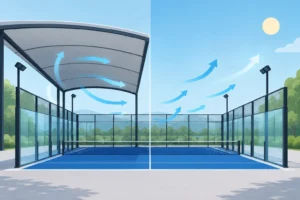
For covered projects, evaluate the canopy as part of the financial model rather than an optional add-on. Weather protection may increase usable hours and improve customer retention, but it also changes the capital requirement, planning path and structural design. The return depends on local climate, booking demand, tariff potential and the operator’s ability to programme the additional capacity.
A manufacturer such as inCourts can support this process by aligning court model, technical requirements and installation scope with the commercial ambition of the scheme. That clarity makes quotations more useful for both investors and finance providers.
Prepare the documents financiers expect
A strong funding proposal is concise, specific and evidence-led. It should explain the site, target customers, local competition, court configuration, project timetable and management team’s experience. Include a detailed cost plan, supplier quotations, planning position, three-to-five-year forecasts and clear assumptions behind utilisation and pricing.
Do not hide risks. Address them directly: weather exposure, planning uncertainty, construction overruns, staffing, local competition and slower-than-expected uptake. Then show the mitigations, whether that is a covered court strategy, a staged rollout, pre-sale memberships, coaching partnerships or a larger contingency reserve.
Finance becomes easier when the proposal demonstrates control. Funders need to see that the team understands not only the opportunity in padel, but the practical work required to operate a profitable facility.
The most effective next step is to turn an early court quotation into a complete investment model: site costs, funding mix, launch timetable and conservative revenue assumptions. When every element supports the same commercial case, the project is ready to earn serious consideration.


No comment yet, add your voice below!