

A court can look impressive on opening day and still become an expensive operational problem within a few seasons. That is why premium padel court reviews should go beyond photographs, headline prices and a short specification sheet. For club owners, developers and leisure operators, the real question is whether a court will preserve its playing quality, visual appeal and structural integrity under sustained commercial use.
Premium padel is a capital investment, not a commodity purchase. It affects membership sales, court utilisation, maintenance planning, insurance confidence and the overall standard guests associate with a venue. The best assessment therefore combines engineering detail with the commercial realities of operating a busy facility.
Premium Padel Court Reviews: What Buyers Should Assess
A meaningful review starts with the intended operating environment. An indoor court at a private members’ club faces different demands from an outdoor installation at a public sports centre or a high-turnover hospitality venue. Weather exposure, available space, expected booking volume and the profile of players should shape the decision from the outset.
The term ‘premium’ is often used loosely. In practice, it should mean a carefully engineered structure, high-quality materials, precise manufacturing, refined finishing and an installation process that protects both safety and appearance. It should also mean that the supplier can explain why each design choice has been made.
A lower initial price may suit a limited-budget scheme, particularly where padel demand is still being tested. However, it can carry a higher long-term cost if coatings deteriorate quickly, glass alignment is poor, fittings loosen or the court fails to create the premium first impression required to support higher booking rates. The right choice depends on the project, but the comparison must be made over the court’s working life, not simply at quotation stage.
Structure Is the Starting Point, Not an Optional Extra
The steel structure is the court’s backbone. It supports the glazing, withstands player impact and must remain stable through wind, temperature change and continuous use. A premium court should use properly specified structural steel, formed and finished with consistency, rather than relying on visual weight alone as proof of strength.
Buyers should ask how the structure has been engineered for its location and whether the manufacturer can adapt details for local wind conditions, foundations and cover systems. Outdoor projects need particular attention. A court installed in an exposed coastal or elevated setting cannot be assessed in the same way as one protected within an enclosed urban site.
Finishing matters as much as the initial steel specification. Powder coating should provide an even, durable surface that complements the wider venue design while helping protect the metal beneath. Look closely at joints, welds, fixings and difficult-to-reach areas. These are the details that reveal manufacturing discipline and influence future maintenance requirements.
Panoramic design versus framed stability
Panoramic courts are often the preferred choice where presentation is central to the investment. Their reduced visual obstruction improves sightlines for spectators, creates stronger content opportunities and gives the facility a more professional visual identity. For flagship clubs, competition venues and premium hospitality settings, this can be commercially significant.
A full panoramic configuration takes that visual clarity further, producing a cleaner playing enclosure and an elevated spectator experience. It is particularly effective where the court is positioned as the centrepiece of a development. The engineering must match the ambition, however. Removing visible structural elements demands disciplined design, accurate glass support and dependable anchoring.
Pilar-style courts remain a strong option for projects where durability, value and a more conventional structural expression are priorities. They can be a sensible route for multi-court roll-outs, community facilities or operators balancing quality with a tightly controlled capital budget. Premium does not always mean choosing the most visually minimal model. It means selecting the model that properly serves the site and business plan.
Glass, Mesh and Playing Character
Padel players quickly notice whether a court feels precise. Glass panels should be correctly specified, consistently aligned and installed to maintain predictable rebound behaviour. Poor alignment or inadequate tolerances can affect play, create visible gaps and undermine the polished appearance expected from a premium facility.
The relationship between glass, mesh and frame deserves close scrutiny. Mesh must be sufficiently strong for repeated ball strikes and player contact, while its profile and placement should avoid unnecessary visual clutter. Gates should operate cleanly, sit accurately within the enclosure and retain their performance under regular use. These may seem like minor points during procurement, but they affect the daily experience of every player.
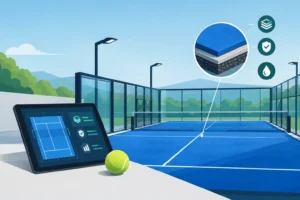
Playing surface selection also requires more thought than choosing a colour. The turf should support consistent ball response, secure footing and appropriate drainage where the court is outdoors. Fibre type, pile density, infill approach and installation quality all contribute to performance. A visually attractive surface that holds water or wears unevenly will quickly become a commercial liability.
Lighting should be reviewed as part of the court, not added at the end. Even illumination supports safe play, clearer camera footage and a more professional customer experience, especially during peak evening hours. The chosen system must suit the court layout, nearby properties and any planning restrictions. Glare, overspill and poorly positioned columns are avoidable issues when lighting is considered early.
Installation Quality Determines the Finished Asset
Even an excellent court design can be compromised by weak site preparation or rushed installation. A specialist supplier should take responsibility for the complete delivery sequence: site assessment, foundation coordination, production, logistics, assembly, final checks and handover.
Groundworks require particular care. Level tolerances, drainage routes and base design affect the entire structure above them. If the slab is inaccurate, installers are forced to compensate during assembly, which can affect alignment and appearance. For new venues, this stage should be coordinated with access routes, electrical provision, drainage infrastructure and any planned canopy.
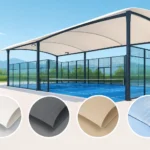
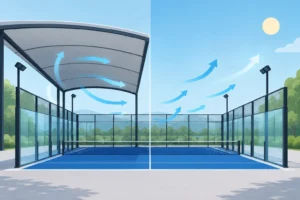
A padel canopy can materially improve court availability in the British climate, but it changes the project requirements. Its loads, clearance, drainage and relationship to lighting must be resolved as one engineered system. Treating the cover and court as separate purchases can create avoidable interfaces, delays and design compromises.
Ask prospective manufacturers who will install the court, how they control quality on site and what is included in the handover process. A professional installation team brings more than labour. It brings repeatable methods, accurate sequencing and accountability when conditions on site differ from the original plan.
Assessing Value Beyond the Quotation Total
The most useful premium padel court reviews compare total value rather than the lowest number at the bottom of a proposal. A serious investment case considers expected court utilisation, positioning within the local market, maintenance exposure and the venue’s ability to command premium prices.
A visually distinctive court can strengthen launch marketing and help a club stand out in a crowded catchment area. Yet aesthetics alone will not retain players. The asset must play well, withstand intensive use and continue to look credible after thousands of bookings. That is why structural specification, finish quality and installation competence should carry equal weight in procurement.
It is also sensible to assess the manufacturer’s project capability. Can it produce at scale for a multi-court development? Can it provide clear technical documentation? Does it understand transport, access constraints and installation sequencing? A supplier that manufactures, engineers and installs has greater control over the details that determine the final result.
For investors planning several courts, consistency is especially valuable. Matching heights, colours, mesh profiles, lighting positions and branding opportunities across the site produces a coherent venue rather than a collection of separate installations. It also makes future expansion easier to plan.
Questions That Expose the Difference
Before appointing a supplier, decision-makers should request clarity on the structural design, coating system, glass specification, turf and lighting package, installation scope, programme and aftercare arrangements. They should also ask which assumptions sit behind the quotation. Foundation works, drainage, lifting equipment, access limitations and electrical connections can all alter the real project cost.
A manufacturer should be comfortable discussing trade-offs. A full panoramic court may be the strongest commercial statement, while a Pilar model may deliver better value across a larger roll-out. A canopy may increase capital expenditure, but it can protect revenue through wetter months. Clear advice is more valuable than a generic recommendation.
inCourts approaches these decisions as an infrastructure project, combining premium court models with engineering-led production and professional installation. That perspective helps buyers assess not just what the court will look like at launch, but how it will perform as a long-term business asset.
The most successful padel venues are built around confidence: confidence in the playing experience, confidence in the structure and confidence that the court will keep earning its place at the centre of the facility. Choose the specification that supports that confidence from the ground up.


No comment yet, add your voice below!