

A padel court is a revenue-generating asset, not a short-life piece of sports equipment. When assessing what warranty covers padel courts, owners should look beyond the headline term and establish exactly which components, defects and remedial costs are included. The difference can materially affect operating risk, maintenance budgets and the long-term appearance of a facility.
A meaningful warranty gives a club, developer or operator confidence that the manufacturer stands behind its engineering and production quality. It should also make clear where that responsibility ends. Courts are exposed to repeated ball impact, player contact, changing weather, moisture, cleaning regimes and, in some locations, demanding wind or snow loads. A warranty must be read alongside the technical specification, installation scope and maintenance requirements.
What warranty covers padel courts in practice?
There is no single industry-wide padel court warranty. Coverage, duration and conditions vary by manufacturer, court model, installation location and contract. However, a well-defined package usually separates structural components, glass, playing surfaces, lighting and installation workmanship rather than treating the court as one undifferentiated product.
The strongest warranties are specific. They identify the component, the defect covered, the warranty period, the claim process and the remedy available. Broad assurances about quality may sound reassuring during procurement, but they do not replace written contractual terms.
Structural steelwork and court framework
The primary steel structure is the core of the court. This includes columns, frames, mesh panels, fixings and the engineered elements that support the glass and enclosure. Warranty protection commonly applies to defects in materials, fabrication and manufacturing workmanship, provided the court has been installed and used in accordance with its design parameters.
For an outdoor court, the specification must be appropriate for the site. Wind exposure, local weather conditions, ground conditions and the required structural calculations all matter. A structural warranty will not normally compensate for a court placed on inadequate foundations, altered after installation, or exposed to loads outside those it was designed to withstand.
The protective finish deserves separate attention. Galvanising and powder coating are central to corrosion resistance and visual quality, especially in coastal, high-humidity or heavily used environments. Coverage may apply where a finish fails prematurely because of a production defect. It may not apply where corrosion follows impact damage, standing water, abrasive cleaning methods or neglected repair of damaged coating.
Toughened glass panels and fittings
Padel glass must deliver safety, visibility and consistent rebound characteristics. A warranty may cover manufacturing defects in the glass itself or defects in supplied fittings, such as clamps, gaskets and fixings. It should be clear whether replacement glass, labour, access equipment and disposal of damaged panels are included if a valid claim is accepted.
Glass breakage is often treated differently from a manufacturing defect. Breakage caused by impact, vandalism, misuse, unauthorised alterations or external events is frequently excluded. This is not necessarily a weakness in the warranty. It reflects the distinction between a defect in the product and accidental damage that should be managed through site security, operating procedures and insurance.
Artificial turf, infill and playing performance
The playing surface is a high-contact element and naturally has a different risk profile from the steel structure. A turf warranty may cover manufacturing faults such as premature fibre failure, backing defects or abnormal degradation under specified conditions. It is less likely to cover ordinary wear, contamination, poor brushing, incorrect sand levels or damage caused by inappropriate footwear and maintenance equipment.
Owners should confirm the required maintenance programme before handover. A surface can only perform as intended when it is brushed, cleaned and inspected at appropriate intervals. If the warranty is conditional on documented maintenance, a club should assign that responsibility clearly rather than treating it as an informal operational task.
Lighting, electrical equipment and accessories
Floodlights, LED fittings, electrical drivers and control systems may carry separate manufacturer warranties. Their terms can differ from the court structure in both duration and remedy. Electrical components are also dependent on correct installation, voltage stability and suitable protection from water ingress.
Accessories such as nets, posts, gates, door mechanisms and padding may be covered for material or manufacturing defects, but they are generally considered wear items. Their expected service life will be influenced by court usage and daily handling. For a busy commercial club, it is sensible to budget for periodic replacement independently of warranty coverage.
Canopies and weather-protection systems
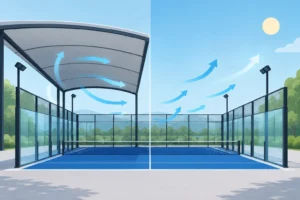
Where a project includes a padel canopy cover, its warranty should be documented separately from the court warranty. The supporting structure, roof membrane, drainage, fasteners and lighting integration each have their own technical requirements. Water management is particularly significant: blocked gutters, poor site drainage or unauthorised additions to the roof can affect both performance and coverage.
What is usually excluded from a padel court warranty?
Exclusions are not small print to ignore. They define the operational responsibilities that remain with the owner. Most warranties exclude normal wear and tear, accidental damage, vandalism, misuse, inadequate cleaning, lack of maintenance and damage caused by third parties.
They may also exclude defects arising from unauthorised modifications. Adding signs, cameras, extra lighting, netting or roof attachments without engineering approval can change loads or interfere with drainage and access. The same applies when a third party carries out repairs using non-approved parts or methods.
Environmental events are another area to check carefully. Exceptional storms, flooding, subsidence, fire and other events outside the agreed design basis may fall outside the manufacturer warranty and within the scope of the owner’s insurance. This is especially relevant for exposed outdoor sites, where early technical assessment is more valuable than a generic warranty promise.
The warranty terms that determine real value
The duration of cover matters, but it is only one part of the decision. A longer period with narrow exclusions or unclear claim handling can provide less protection than a shorter, precise warranty from a manufacturer with direct control over production and installation.
Before placing an order, decision-makers should establish whether the warranty begins on delivery, installation completion or formal handover. For phased developments, that distinction can be commercially significant. They should also ask whether the remedy is repair, replacement or a contribution towards the cost, and whether labour, transport, lifting equipment and site access are included.
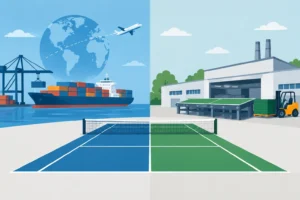
Geography matters for international projects. A supplier may manufacture in one country and install in another through its own teams or approved partners. The contract should state who will inspect a claim, who will carry out remedial works and how reasonable response times are managed. A replacement component is not a complete solution if fitting it requires specialist access equipment and the responsibility for that work is unclear.
Documentation is equally important. The owner should retain the signed specification, structural calculations where applicable, installation records, product data, maintenance guidance, commissioning details and photographs from handover. These records make it easier to establish whether a defect falls within the agreed scope and whether the court has been maintained correctly.
Product warranty and installation warranty are not the same
A court can be manufactured correctly yet perform poorly if it is installed on unsuitable foundations or assembled incorrectly. For this reason, buyers should distinguish between the product warranty and the installation workmanship warranty.
The product warranty concerns components supplied by the manufacturer. The installation warranty concerns the quality of assembly, alignment, fixing and completion of the agreed works. Foundations may sit under a separate civil works agreement, particularly where a local contractor prepares the base. If so, responsibilities for levels, drainage, concrete strength and anchor locations need to be coordinated before the court arrives on site.
A turnkey supplier offers a practical advantage because the engineering, manufacturing and installation teams work to one technical standard. At inCourts, this integrated approach is designed to reduce handover gaps between the court design, the manufactured structure and final installation. Even so, the contractual scope should always identify who is accountable for every part of the project.
Questions to resolve before signing
A buyer does not need a lengthy legal exercise to assess warranty quality, but four questions should be answered in writing: which individual components are covered; what circumstances void or limit coverage; who pays for inspection and remedial work; and what maintenance evidence must the operator retain.
It is also sensible to request the warranty document during the quotation stage, not after a purchase order is issued. This allows competing proposals to be compared on more than court appearance, price and delivery schedule. Premium panoramic designs, such as Full Panoramic courts, demand the same disciplined approach as more budget-conscious court formats: their visual impact is valuable, but their long-term performance depends on engineered detail and accountable delivery.
A padel court warranty should reinforce a well-engineered project, not compensate for an unclear one. Choose a supplier that defines the court, the installation scope and the aftercare responsibilities with precision, then keep the handover records and maintenance routine as carefully as the court itself.


No comment yet, add your voice below!