

A wet court at 6pm is not simply an operational inconvenience. For a club, it means cancelled bookings, frustrated members and revenue that cannot be recovered. The best weather protection for padel is therefore not a cosmetic add-on to a court project. It is a structural investment that protects playing availability, customer experience and the long-term value of the facility.
For most commercial venues in the UK and similarly variable climates, a purpose-designed padel canopy provides the strongest balance of protection, open-air character and commercial practicality. However, the right specification depends on local wind and snow loads, site exposure, drainage, foundations, court configuration and the standard of finish expected by the market.
Best weather protection for padel starts with the structure
A quality canopy should be engineered as part of the court environment, not positioned above it as a generic shelter. Padel has demanding requirements: the cover must clear the playing area comfortably, preserve the trajectory of high balls, allow safe circulation around the court and avoid compromising panoramic sightlines.
The structure also needs to manage the forces created by weather. Wind loads can be significant on exposed sites, particularly where a club is located near open countryside, coastal areas or taller buildings that channel gusts. Snow loading must be assessed for the project location, while the frame, fixings and foundations must work together as a complete engineered system.
This is where low-cost, lightly specified covers can create risk. A canopy may look adequate on a drawing yet lack the structural calculation, steel section strength or foundation design required for its setting. For investors and operators, the real question is not whether a roof can be installed. It is whether the complete installation will remain safe, stable and visually credible through years of British weather.
Clear height is a playing-performance issue
Padel is defined by dynamic overhead shots, lobs and defensive recovery. Limited headroom changes the game and can make a court feel compromised, even if it technically remains playable. Canopy height should be planned around the intended user level, from social club play through to intensive coaching and competitive programming.
A generous, well-designed roof volume also improves the sense of space. This matters commercially. Premium players expect a facility that feels purpose-built, rather than an outdoor court placed beneath an industrial shelter.
Protect the court without closing it in
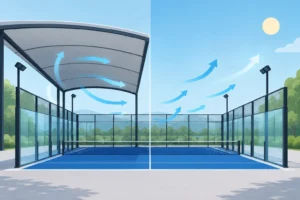
The strongest padel venues retain the open, social atmosphere that makes the sport attractive. A canopy protects the central playing surface from rain and direct sun while allowing natural ventilation through the sides. This is often preferable to a fully enclosed building where planning, cost, heat management and operating complexity can increase considerably.
Open-sided canopies are not suitable for every site. Very exposed locations may need carefully considered side screening or additional weather measures. Yet screening introduces trade-offs: it can change wind behaviour, affect views and increase the visual mass of the structure. The design should respond to site conditions rather than follow a standard template.
Drainage decides whether protection performs
A canopy prevents rain falling directly on the court, but it does not remove the need for proper water management. Rainwater collected across a large roof area must be directed safely away through gutters, downpipes and a drainage strategy matched to the site.
Poor drainage can cause standing water around the perimeter, undermine hardstanding areas or create slippery access routes. It can also damage the customer impression of a premium facility. Players may accept rain outside the canopy; they will not accept puddles at court entrances or water running across walkways.
Drainage planning should account for roof runoff, ground gradients, existing site drainage capacity and local rainfall conditions. It must also be coordinated with electrical services, access routes and maintenance requirements. Downpipes should be protected from accidental impact and positioned so they do not interfere with circulation or the visual clarity of the court.
Condensation needs active consideration
The underside of a roof can develop condensation when temperature and humidity conditions change. This is particularly relevant during cold, damp periods when courts are busy in the evening. Drips from a canopy are just as disruptive as light rain if they fall into the playing area.
Roof material, insulation approach, ventilation and the geometry of the canopy all influence condensation behaviour. There is no single answer for every location, but it should be addressed during design rather than after opening. A technically informed supplier will discuss this alongside structural loading and drainage, not treat it as a minor finishing detail.
Materials and finishes should match the asset life
A padel canopy is a highly visible capital asset. It sits above the court, often above the rest of the venue, and will influence how prospective members, partners and developers judge the entire project. Material selection must therefore combine durability with visual discipline.
Galvanised and coated steel structures are widely used because they provide the strength required for larger spans and demanding weather conditions. The quality of fabrication, surface preparation, coating specification and connection details matters as much as the headline material. Corrosion protection is particularly important in coastal environments, high-humidity areas and sites exposed to pollution.
Roof cladding should be selected for light transmission, acoustic behaviour, thermal movement and maintenance as well as rain protection. A brighter court is desirable, but excessive glare can affect play. Transparent or translucent elements can create an attractive daytime environment, although they need to be specified carefully to control solar gain and maintain comfortable visibility.
The best result is rarely the cheapest roof sheet paired with the simplest frame. It is a coherent system with materials that perform together and retain a clean appearance over time.
Lighting must be designed with the canopy
Installing a cover after lighting has been planned often leads to compromised results. Roof beams can create shadows, reflective surfaces can introduce glare and poorly positioned fittings can make the ball difficult to track against the ceiling.
Lighting should be integrated into the canopy and court design from the start. The objective is even illumination across the full playing area, with fittings protected from impact and arranged to minimise glare for players looking upwards. Electrical routes, access for maintenance and the relationship between lights and drainage should all be resolved before manufacture.
For operators, this coordination has a direct commercial benefit. A well-lit covered court supports dependable evening bookings throughout the year, while a poorly lit one limits the value created by the structure.
Choose a canopy around the business model
The appropriate level of weather protection depends on how the courts will earn revenue. A members’ club with high peak-time demand may prioritise maximum year-round availability. A hospitality or resort setting may place greater value on architectural appearance and a lighter visual footprint. A municipal project may require a durable, low-maintenance specification that can withstand intensive public use.
Before committing to a design, decision-makers should establish four project fundamentals:
- expected booking demand and the revenue lost during wet-weather closures;
- local planning constraints, including height, appearance and site boundaries;
- site-specific wind, snow and ground conditions; and
- the intended operating standard, from community access to premium club membership.
These considerations determine whether a single-court canopy, multi-court cover or more extensive enclosure is commercially justified. They also help avoid over-specifying features that do not serve the project, or under-specifying the structure and later facing disruption, remedial work or an underperforming customer experience.
Installation quality protects the investment
Even the most capable canopy design depends on accurate installation. Foundations must be set out precisely, steelwork must be aligned correctly, roof elements need reliable sealing and all interfaces with the court environment must be finished cleanly. Poor tolerances can affect drainage falls, panel alignment and the overall visual standard.
A turnkey manufacturer-led approach reduces the gaps that can appear when court supply, canopy design, civil works and installation are handled by disconnected parties. Coordination is especially valuable on multi-court developments, where access for machinery, sequencing of construction and shared services require disciplined planning.
At inCourts, weather protection is considered as part of the wider padel infrastructure package: court model, structural design, premium finish and installation delivery must reinforce one another. That approach allows club owners and developers to create facilities that look considered from day one and continue to perform under regular use.
The right cover makes availability a competitive advantage
A weather-protected court gives a venue more than dry playing conditions. It gives coaches confidence to schedule programmes, players confidence to book ahead and operators a stronger basis for recurring revenue. It can extend usable hours, improve retention and make a new facility more credible to commercial partners.
The most effective projects treat the canopy as a core part of the investment case. Specify it early, engineer it for the site, integrate it with lighting and drainage, and insist on a finish that reflects the quality of the court beneath it. When the weather turns, that preparation is what keeps the calendar full.

No comment yet, add your voice below!