

A padel court investment can look compelling on a revenue forecast, yet the funding structure will often decide whether the project has room to grow or becomes constrained from opening day. The best financing options for padel projects match repayment commitments to realistic court utilisation, construction timing and the wider commercial plan – not simply the lowest headline interest rate.
For club operators, developers, hospitality groups and entrepreneurs, padel is a capital project with several moving parts. Courts, groundworks, lighting, drainage, electrical works, access, buildings and canopies may all sit within the same budget. Each element has a different useful life, security value and impact on cash flow. A well-structured funding package recognises those differences.
Start with the project economics, not the finance product
Before approaching a lender or investor, define what the facility must achieve commercially. A lender will want to understand court numbers, booking rates, peak and off-peak pricing, coaching income, membership strategy and operating costs. An equity partner will focus more closely on growth potential, exit value and management capability.
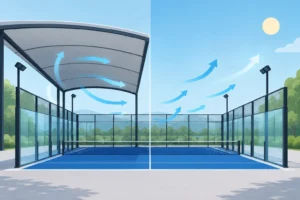
The base case should be conservative. Model a phased ramp-up in utilisation rather than assuming mature occupancy from month one. Include staffing, software, cleaning, maintenance, insurance, marketing, business rates, utilities and debt servicing. Where an indoor or covered operation is planned, also assess the benefit of more dependable year-round availability against the higher initial capital requirement.
A premium court installation can support stronger pricing and member retention, but only when it is positioned correctly within the local market. Panoramic visibility, clean finishes, high-quality playing conditions and professional lighting contribute to the customer experience. They do not remove the need for disciplined site selection and credible demand assumptions.
Asset finance for padel courts and equipment
Asset finance is often one of the most practical routes for established operators purchasing courts, lighting systems and selected infrastructure. Under hire purchase, the business pays an initial deposit followed by fixed instalments, normally taking ownership at the end of the agreement. This can preserve working capital that would otherwise be tied up in the full court purchase.
A finance lease may suit a business that prioritises use of the asset rather than ownership. Repayments are spread across an agreed term, and the structure may offer greater flexibility depending on the lender and the asset. Operating leases can also be considered in limited circumstances, although their suitability depends on the lender’s appetite for specialist sports infrastructure and the terms offered.
The main advantage is clarity. Fixed repayments make budgeting simpler, particularly for a mature club with predictable booking income. The trade-off is that asset finance rarely covers every part of a development. Ground preparation, planning costs, drainage, foundations, access works and professional fees may require cash, separate borrowing or another funding source.
For this reason, asset finance works best when the project has a defined equipment component and a reliable operating history. It may be less suitable for a new venue with no trading record, particularly if the lender requires personal guarantees or significant security.
Commercial loans and mortgages for site-led projects
A commercial term loan is a stronger option where the padel development forms part of a wider leisure facility or property strategy. It can fund a broader package than equipment finance, potentially including construction works, fit-out and site improvements. Repayments are usually structured over a longer period, which can reduce monthly pressure compared with shorter asset-finance terms.
For businesses buying a freehold site or making major permanent improvements, a commercial mortgage may be appropriate. The security is primarily the property, rather than the courts alone, and the lender will examine loan-to-value, rental or trading income, borrower experience and the resilience of the business plan.
This route can be efficient for established operators with property security, but it is not automatically the cheapest or fastest. Valuations, legal work and lender due diligence can extend the timetable. Borrowers should also consider whether fixed or variable rates suit their risk profile. A lower variable rate may be attractive initially, but rate movement can materially affect a venue operating with tight margins.
Development finance for larger padel schemes
Development finance is designed for projects with a defined build programme, particularly new clubs, multi-court destinations and mixed-use leisure developments. Funds are typically drawn in stages as the works progress, rather than released in one payment at the outset. This can align borrowing with construction milestones and help manage cash deployment.
It is a specialist form of finance and usually carries greater cost than a conventional commercial loan. Lenders will expect detailed build budgets, planning status, contractor information, programme certainty, contingency provision and a credible repayment route. That repayment route might be refinancing onto a commercial mortgage once the venue is operating, the sale of the completed asset, or a planned equity event.
For padel projects, buildability matters. Ground conditions, drainage requirements, power capacity, weather exposure and canopy design should be assessed early. An incomplete budget is one of the quickest ways for a promising project to lose financial control. Allow a contingency that reflects site risk rather than choosing a figure because it makes the spreadsheet look more attractive.
Equity investment and joint ventures
Equity is often the right answer when a project is new, ambitious or unable to support heavy debt during its first trading period. Equity investors provide capital in exchange for ownership, a share of future profits or a defined return. Unlike debt, equity does not usually require fixed monthly repayments from the first month of operation.
The cost is dilution and shared control. Investors may expect board rights, reporting obligations, a preferred return, restrictions on future borrowing or a clear route to exit. Those terms should be agreed carefully at the beginning, particularly where founders are contributing the concept, operating expertise and site opportunity rather than most of the cash.
A joint venture can be especially effective when the parties bring different strengths. A property owner may contribute a suitable location, an operator may manage the venue and an investor may fund construction. The agreement must set out capital contributions, decision-making, operating responsibilities, profit distribution and what happens if further funding is required.
Combining finance sources is often the strongest approach
The best financing options for padel projects are frequently combined rather than chosen in isolation. A developer might use equity for land, planning and early-stage risk; development finance for construction; and asset finance for courts and equipment. An existing club may use retained cash for enabling works, finance the court package and retain an overdraft facility for working capital during launch.
This approach can create a more sensible match between funding duration and asset life. Long-lived property improvements should not normally be financed through short-term borrowing. Equally, using expensive long-term debt for equipment that could be financed separately may reduce flexibility.
A layered structure also needs careful coordination. Different lenders may have competing security requirements, and one funder’s approval may depend on another source being committed. Build the capital stack early and ensure the documentation, drawdown timetable and security position are understood by all parties.
What lenders and investors need to see
A serious funding proposal should present the project as an operating business, not simply a court purchase. Provide a detailed capital expenditure schedule, supplier quotations, site plan, programme, revenue assumptions and monthly cash-flow forecast. Show how the venue will acquire customers, not just how many customers the local area contains.
For premium projects, explain why the product specification supports the commercial model. High-quality structures, panoramic court designs and covered playing environments can differentiate a venue, strengthen its visual identity and protect playing capacity. The case must still show that the additional investment produces a commercial benefit through pricing, utilisation, retention or event potential.
Working with an experienced manufacturer can also improve funding readiness. A clear quotation, technical specification, installation programme and defined scope reduce uncertainty for the borrower and for the funder. inCourts supports this process through court manufacturing and project delivery built around the requirements of each site.
Protect the project after finance is agreed
Do not treat funding approval as the final financial decision. Monitor construction costs against budget, maintain a cash reserve for delays and track bookings against the ramp-up forecast from launch. If performance is ahead of plan, surplus cash can strengthen reserves or reduce debt. If performance is behind, early action on pricing, programming, partnerships and marketing is far more effective than waiting for a repayment problem.
The right finance should give a padel project enough structure to perform and enough headroom to develop. Build the case around realistic demand, durable infrastructure and a repayment profile the business can carry in ordinary trading months, not only in its best ones.




No comment yet, add your voice below!