

A padel court quotation is not simply a price for steel, glass and turf. It is a commercial blueprint for an asset expected to generate revenue, attract players and withstand intensive use for years. To evaluate court quotations properly, club owners, developers and facility operators must compare what is included, how the court is engineered and where cost risk may emerge after the order is placed.
The lowest figure can look compelling at the approval stage. Yet a quotation that omits foundations, freight handling, installation equipment, electrical preparation or glass specifications can become substantially more expensive before the first match is played. The strongest investment decision comes from comparing equivalent scopes, not headline totals.
Start by defining the project scope
Before comparing suppliers, establish what your project requires. Is the court intended for a high-volume commercial club, a hotel facility, a private development or a municipal sports centre? Each environment creates different demands around player capacity, visual impact, operating hours, site access and long-term maintenance.
A flagship venue may prioritise full panoramic visibility, premium lighting and a finish that supports a higher membership or booking rate. A growing club may need to optimise capital expenditure across several courts while retaining the structural quality required for continuous play. Neither approach is automatically better. The right quotation is the one aligned with your business model, site conditions and expected return.
Ask each supplier to quote against the same brief: court model, quantity, location, foundation status, lighting requirement, turf specification, access restrictions and preferred installation date. Without a consistent brief, comparing quotations becomes an exercise in comparing different projects.
Evaluate court quotations beyond the total price
A professional quotation should make the supplied scope clear enough for a project team to verify. If broad descriptions replace technical detail, there is room for assumptions on both sides. That uncertainty is where budget pressure develops.
Check the court structure and materials
The court frame is the core of the investment. Review the type and thickness of structural steel, corrosion protection process, fixing systems and connection details. Galvanisation, coating quality and finishing standards matter particularly for outdoor installations, coastal environments and venues with frequent rain or temperature variation.
Glass is another area where specifications should be explicit. Confirm the glass thickness, tempering standard, panel arrangement and fixing method. Panoramic designs require engineering precision because reduced visible structure must still deliver rigidity, safety and consistent ball rebound. A clean visual result should never come at the expense of structural strength.
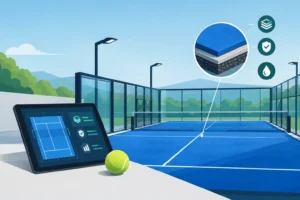
Turf deserves the same scrutiny. Ask about pile height, fibre composition, backing, infill requirements and line integration. The playing surface influences player perception immediately, but it also affects maintenance needs and replacement planning. A low initial turf cost may be false economy if the product loses performance quickly under commercial footfall.
Compare the court model, not just the dimensions
Most padel courts share standard playing dimensions, but their design, finish and market positioning can differ significantly. A Pilar court may offer an efficient, high-quality route into padel for projects where budget discipline is central. A Panoramic Premium or Full Panoramic Premium design can create a more elevated visual experience, with clearer spectator sightlines and a presentation suited to premium clubs, events and hospitality settings.
The decision should reflect the venue’s commercial proposition. If your business depends on social media visibility, coaching content, tournament hosting or premium guest experience, court aesthetics can support demand and pricing power. If the priority is rapid expansion across multiple locations, a model with strong engineering and efficient deployment may produce the better return.
Separate product cost from project delivery cost
A court can be manufactured to a high standard yet still create problems if delivery and installation are not planned professionally. Review the quotation for the full route from factory to handover.
Freight should state the delivery basis, destination, estimated loading arrangement and whether local duties, import processes or port charges are included. For international projects, this clarity is essential. A competitive factory price is not the same as a predictable delivered project cost.
Installation should define what the installation team will undertake and what remains the client’s responsibility. Confirm whether the quotation covers assembly, glazing, turf installation, lighting installation, machinery, lifting equipment, travel, accommodation and site supervision. If specialist access equipment is needed, establish who supplies it and whether the site can accommodate it.
Foundation work is frequently treated as a separate package, but it must be coordinated with the court supplier’s drawings and tolerances. The slab must be level, correctly dimensioned and ready when the installation team arrives. A delayed or inaccurate base can affect programme, installation quality and additional labour costs.
Identify exclusions before they become variations
Every quotation will have exclusions. That is normal. The concern is not the existence of exclusions but whether they are visible, understandable and priced elsewhere in the project budget.
Look closely for items such as civil works, drainage, electrical supply, perimeter paving, planning permissions, crane hire, unloading, local accommodation, customs clearance, fencing outside the court footprint and spectator infrastructure. Lighting may include poles and luminaires but exclude the electrical feed to the courts. Turf may be included while the infill material or maintenance equipment is not.
Request a written inclusions and exclusions schedule where necessary. It gives project managers, investors and procurement teams a practical document to use when testing the total capital requirement. It also prevents a supplier being judged unfairly for work that was never intended to form part of its package.
Test the supplier’s engineering and delivery capability
Court quotations are only as dependable as the organisation behind them. A padel court is a technical structure installed in a live commercial environment, not a commodity purchase. The supplier should be able to explain how it controls manufacturing quality, protects components in transit and manages installation on site.
Ask for details of manufacturing capability, quality controls, production lead times and installation experience. A supplier with direct control over design and manufacturing is generally better positioned to maintain consistency across court components and respond when a project requires adaptation.
It is also sensible to assess communication quality during the quotation stage. Are drawings, specifications and assumptions supplied promptly? Does the supplier ask relevant questions about site conditions? Are technical points answered with precision? These early interactions often indicate how the project will be managed once production starts.
For premium developments, design flexibility may be material. Bespoke colours, branded elements, canopy integration and site-specific adaptations can strengthen the finished facility, but they require early technical coordination. Confirm whether bespoke requests affect lead time, engineering approval or warranty terms.
Consider lifecycle value and revenue potential
The most useful quotation analysis includes both capital expenditure and operating value. A court that presents well, performs consistently and requires fewer corrective interventions can protect your reputation with players while supporting stronger occupancy over time.
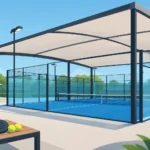
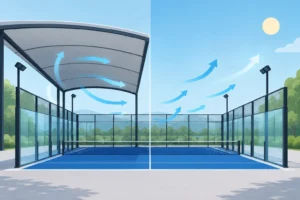
Consider the anticipated use of the facility. High-frequency commercial venues need durable components, reliable lighting and a surface designed for sustained demand. Covered courts introduce another layer of value in the UK climate: greater availability through rain, wind and low-light periods. However, a canopy must be evaluated as part of the wider site design, including wind loads, drainage, planning considerations and the playing environment beneath it.
Warranty terms should be read alongside the maintenance obligations. A long warranty is helpful only when the coverage, exclusions and reporting process are clear. Establish who provides technical support after handover, what spare-part availability looks like and how installation-related issues are addressed.
Use a like-for-like comparison sheet
When several quotations are under review, create one comparison sheet for decision-makers. Do not rely on memory or a single total at the bottom of each proposal. Record the court model, structural specification, glass, turf, lighting, freight terms, installation scope, foundations, exclusions, programme, warranty and payment schedule.
This process often reveals why one proposal is cheaper. Sometimes the difference is justified and appropriate for the project. At other times, it reflects a missing item, a lower material specification or a delivery assumption that will later transfer cost back to the client.
Price remains important. Investors and operators need a disciplined capital plan. But the commercial question is not simply, “Which court costs less?” It is, “Which proposal gives this venue the greatest certainty of quality, opening readiness and long-term earning potential?”
A well-evaluated court quotation gives your project a stronger starting position. Choose the partner that can clearly define the product, stand behind the engineering and deliver a court that matches the level of ambition behind your facility.

No comment yet, add your voice below!