

A padel canopy is not an accessory added after the court is complete. It is a major infrastructure decision that affects playing availability, member satisfaction, operating costs and the perceived standard of a venue. A serious padel canopy performance review should therefore look beyond whether the roof keeps rain off the playing surface. The question for investors and operators is whether the complete structure will protect revenue-generating court time while preserving the quality of padel.
What canopy performance means in a padel facility
Performance starts with availability. In the UK, persistent rain, low winter light and wind can quickly turn an uncovered court into an unreliable asset. A well-designed canopy extends usable hours and creates a more predictable booking proposition for members, coaching programmes and corporate events.
However, coverage alone is not enough. A canopy that restricts airflow, produces glare, channels water towards the court perimeter or interferes with lighting can compromise the player experience it was intended to improve. The best projects assess the roof, steelwork, drainage, foundations, lighting and court enclosure as one engineered system.
For commercial facilities, this matters because padel is played at pace. Players need clear sightlines to the ball, even light across the playing area and enough open space to use high lobs safely. The canopy must support these requirements without making the court feel enclosed, dark or acoustically harsh.
Padel canopy performance review: the structural test
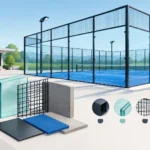
The structural frame carries the long-term responsibility of the installation. It must be specified for the local site, not selected from a generic drawing. Wind exposure, altitude, nearby buildings, coastal conditions, ground composition and anticipated snow loads can all change the engineering requirement.
A credible review examines how loads move through the roof frame and into the foundations. The connection points between canopy columns, court structure and concrete bases deserve particular attention. These are not minor construction details. Poor coordination at this stage can create drainage problems, visual misalignment or difficult access for later maintenance.
Steel quality, protective coatings and fabrication accuracy also influence the asset’s life cycle. Galvanised and suitably finished structural elements help defend against corrosion, particularly in exposed or humid environments. The objective is a clean, durable installation that maintains its visual standard as well as its structural integrity.
Height is another essential consideration. A roof set too low can restrict high defensive lobs and alter the character of play. Yet increasing height can affect planning considerations, structural demands and overall project cost. There is no single correct dimension for every scheme. The right answer depends on the court model, site constraints, intended player level and local approvals.
Weather protection without creating new problems
Rain protection is usually the first reason a club considers a canopy, but water management is where many projects succeed or fail. The roof should collect and direct rainwater away from the court, entrances and circulation areas. Standing water around foundations or player access points creates avoidable safety and maintenance issues.
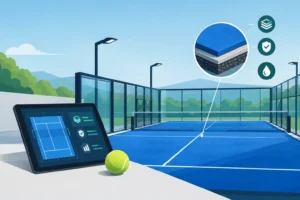
The roof covering itself needs to balance transmission of natural light with solar and glare control. In bright conditions, a highly reflective or poorly selected roof surface can make the ball difficult to track. In darker months, insufficient daylight increases dependence on artificial lighting and can make a premium court feel uninviting.
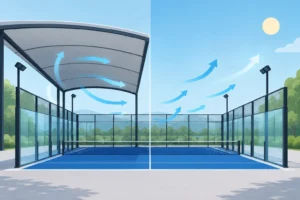
Wind must be considered with equal care. A canopy is not necessarily a fully enclosed building, and that can be an advantage. Open sides preserve ventilation and help avoid a stagnant internal environment. At exposed locations, though, the roof and any side screening need engineering that accounts for uplift and lateral loading rather than simply attempting to block every gust.
For clubs near the coast or in exposed rural areas, the specification should be more demanding. Salt-laden air, driving rain and stronger winds increase the value of appropriate coatings, drainage detailing and properly designed connections. A lower initial specification can prove expensive if it shortens the service life of a high-value court asset.
Light, airflow and the quality of play
Players judge a covered court in seconds. They notice whether the ball disappears against the roof, whether shadows cut across the service box and whether heat or condensation makes the space uncomfortable. These factors are often missed when canopy decisions are driven only by drawings and headline dimensions.
Lighting should be designed with the canopy, not fitted around it. The roof structure must allow sensible luminaire positioning, limit glare and avoid shadows created by beams or columns. Light levels should feel consistent across the full court, including the rear glass and corners where defensive rallies are frequently decided.
Airflow is equally practical. A canopy can reduce the effect of rain and direct sunlight without turning the court into a closed hall. Good ventilation supports player comfort, assists surface drying and reduces the likelihood of moisture lingering beneath the roof. The right balance depends on orientation, prevailing weather and whether the facility is intended for year-round high-volume use.
Acoustics are worth reviewing too, especially at clubs close to homes, hotels or mixed-use developments. Hard roof surfaces can reflect ball impacts and player voices. The solution may involve roof geometry, material selection, screening or site layout. It should be addressed before installation, when changes are easier and less costly.
Assessing operational value, not just capital cost
A canopy adds to the initial project budget, so the business case should be based on realistic operating gains. The strongest case is usually improved court utilisation during wet periods, stronger retention among members and greater certainty for programmed activity. Coaching blocks, leagues and pay-and-play bookings are more valuable when they are less likely to be cancelled.
Operators should test the proposal against their actual business model. A destination club with heavy evening demand may prioritise lighting performance and an impressive visual identity. A tennis club converting underused space may focus on extending shoulder-season play. A hospitality development may place more value on architectural integration and guest comfort.
Maintenance access must also be part of the review. Gutters, downpipes, roof panels, lighting and structural connections need to be inspectable without creating excessive disruption or requiring complicated specialist equipment. Ask how water outlets will be cleared, how replacement components can be obtained and what inspection intervals are recommended.
A cheap canopy can become a costly decision when drainage, coatings or access have been treated as afterthoughts. Conversely, a premium solution only earns its position if it is engineered around the site and supports dependable commercial operation over time.
Making the canopy part of the court strategy
The strongest developments choose the court and canopy together. A panoramic court can benefit significantly from a structure that preserves open views and complements its visual impact. More economical court formats may require a different balance between span, column placement and project budget. Neither route is automatically better; the correct specification reflects the venue’s market position and revenue plan.
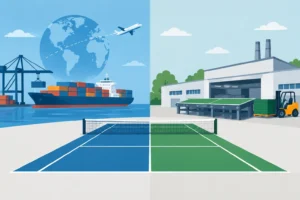
At inCourts, canopy planning is approached as part of a complete padel infrastructure project, connecting court design, structural engineering, manufacturing and installation sequencing. This reduces the risk of discovering avoidable conflicts once construction has begun.
Before approving a proposal, decision-makers should expect clear information on structural design assumptions, roof material, corrosion protection, drainage, lighting coordination, foundation requirements and maintenance provision. They should also confirm responsibilities for surveys, local permissions, installation access and handover. A canopy is too significant an investment to rely on broad assurances.
The most valuable covered court is not simply the one with the largest roof or the lowest quoted price. It is the one that keeps play moving, presents the venue at a premium level and gives owners confidence when the weather is at its worst.


No comment yet, add your voice below!