

A padel court is not a piece of loose sports equipment that can simply be moved indoors when the weather turns. It is a substantial steel, glass and artificial-turf structure that must perform safely through wind, heavy rain and changing ground conditions. So, can padel courts withstand storms? Yes – when the court, foundations, canopy and installation have been specified for the site rather than selected on appearance or price alone.
For clubs, developers and operators, storm resilience is not a secondary technical detail. It protects player safety, reduces unplanned closures and safeguards a long-term revenue-generating asset. The decisive question is not whether a court has glass walls and steel posts. It is whether every part of the system has been engineered to work together under the local environmental loads.
Can padel courts withstand storms in the UK?
A professionally designed and correctly installed padel court can withstand the severe weather typically experienced in the UK. However, the answer depends on location, exposure, court model, ground preparation and the standard of installation.
Wind is usually the main structural concern. A court presents a considerable surface area through its glazing, mesh panels, perimeter framework and, where fitted, canopy structure. Strong gusts do not apply a uniform force. They create pressure on windward faces and suction on leeward sides, while turbulence around buildings, trees and open land can increase local loads.
A sheltered court within an established leisure site has different requirements from one installed on an exposed coastal development, a hilltop, or beside open agricultural land. A supplier should assess the project location before confirming the structural solution. Generic designs and assumptions can create unnecessary risk where wind exposure is high.
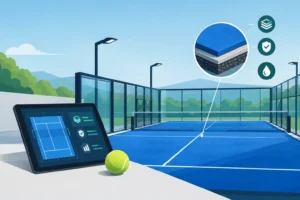
Heavy rainfall creates a different challenge. The court surface may remain playable after rain, but only if water can move efficiently through the turf system and away from the slab. Poor drainage can cause standing water, contamination of the infill, premature surface wear and disruption to bookings. Over time, inadequate water management can also affect the surrounding ground and foundations.
Storm performance starts below the court
The visible court is only one part of the investment. Reliable storm performance begins with civil works, including the concrete base, anchoring arrangement, drainage design and levels around the playing area.
The slab must be level, properly cured and dimensionally accurate so that the steel structure can be fixed as designed. Anchor points must transfer forces from the court into the foundations without movement. If the base is underspecified, cracked, poorly reinforced or incorrectly positioned, even a high-quality superstructure cannot deliver its intended performance.
Drainage should be designed for the site rather than treated as an afterthought. This means considering rainfall intensity, ground permeability, existing drainage routes and where water will discharge. In some projects, a permeable solution and suitable sub-base are appropriate. In others, channels, gullies or a managed connection to the site drainage system will be required.
The area around the court matters as well. Water should not collect against the slab edge or flow from adjoining hardstanding directly on to the playing surface. A well-planned installation protects the court while making the wider facility safer and easier to maintain.
Wind loading, steelwork and anchors
The frame is the primary load-bearing element of a padel court. Steel columns, top rails, mesh sections and connection points need to be manufactured to exact tolerances and protected with a durable finish suitable for outdoor use. Premium powder coating supports long-term appearance, but corrosion protection also has a practical role in preserving the steel beneath it.
Structural design should account for wind loads, the court geometry and the forces transferred through the glass and mesh. Connections are particularly significant. Bolts, plates and brackets must be correctly specified and tightened during installation, because they form the route by which loads travel through the structure and into the slab.
A panoramic court requires especially careful engineering. Its clean sightlines and reduced visual interruption create a premium playing and viewing experience, but the structural system must still manage the loads that more frequent pillars may otherwise distribute. This is why visual refinement and structural strength should never be treated as competing priorities. The best court designs achieve both.
Glass is engineered, not decorative
Tempered glass is a defining feature of padel, yet it is sometimes misunderstood as the vulnerable part of the court. Correctly specified and installed glass is designed for the impacts of play and for its role within the wider structural system.
Storm resilience depends on panel thickness, edge quality, fittings, support details and accurate installation. Glass must sit correctly within its fittings, with suitable tolerances that allow the structure to behave as intended. Incorrect handling, damaged edges or poorly aligned panels can compromise performance even where the original glass specification was sound.
After a significant storm, operators should inspect the glazing visually for cracks, chips, movement or unusual contact between the panel and surrounding steelwork. Any concern should be assessed by qualified personnel. Continuing play around damaged glass is not an acceptable operational risk.
Do canopy covers make a court more vulnerable?
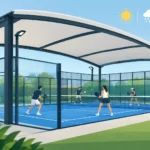
A padel canopy offers clear commercial benefits. It can extend playing hours, improve member experience and protect court surfaces from repeated rain exposure. But a canopy also changes how wind acts on the site, which makes professional design and site assessment essential.
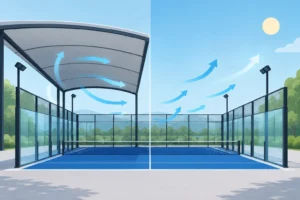
A properly engineered canopy is not simply a roof placed above a court. Its columns, roof form, drainage, fixings and foundations must be designed as a complete structure. Wind can pass around, over and beneath a canopy, creating uplift and lateral forces that require careful calculation. The interaction between canopy and court must also be considered, particularly where space is restricted.
The trade-off is straightforward: greater weather protection requires greater structural planning and capital investment. For a high-utilisation club or hospitality venue, this can be commercially justified by more reliable booking capacity. For a seasonal or lower-volume facility, an open court with excellent drainage and lighting may be the more appropriate first phase.
What operators should check before storm season
Courts do not need constant intervention, but planned inspections help prevent small issues becoming expensive repairs. Operators should arrange routine checks of bolts and fixings, mesh tension, glass fittings, gate operation, surface condition and drainage outlets. Leaves, litter and debris should be removed from drainage channels and surrounding areas before periods of heavy rainfall.
It is also sensible to examine the wider site. Loose signage, temporary furniture, fencing and storage items can become hazards in high winds, even if the court structure itself is secure. Where a site has experienced exceptional gusts, flooding or impact from fallen branches, a professional inspection before reopening provides reassurance for both operators and players.
Maintenance records have commercial value. They demonstrate responsible asset management, support warranty conversations and help a club plan refurbishment expenditure before performance or appearance is affected.
Choosing a court supplier for severe weather conditions
For developers and facility owners, storm resilience should be addressed during quotation and design, not after the court arrives on site. A capable supplier will ask about the location, local exposure, soil and base conditions, access for installation, drainage, surrounding structures and whether a canopy is planned now or later.
The right conversation also includes the intended court model. A flagship full panoramic court may be the right choice where visual impact, spectator visibility and premium positioning lead the business case. A pillar-based model may offer a more economical route while retaining high-quality construction. Neither choice should be made without considering the environmental conditions of the project.
At inCourts, court design, manufacturing and installation are approached as one coordinated process. That matters because structural performance is determined not only by the components produced in the factory, but by how accurately they are installed on a prepared site.
Storms are an unavoidable part of operating outdoor sport infrastructure. They do not have to become a threat to the project. When engineering, foundations, drainage and installation receive the same attention as aesthetics and player experience, a padel court is positioned to serve the facility confidently for years to come.

No comment yet, add your voice below!