

A wet Saturday should not erase a club’s busiest trading hours. That practical reality is a major force behind the growth of covered padel venues: operators are building facilities that can deliver reliable court access, a stronger member experience and more predictable income through every season.
For clubs, developers and leisure investors, a canopy is no longer simply a weather solution. It is an infrastructure decision that affects site capacity, operating model, customer perception and the long-term value of a padel project. The strongest schemes treat the court and its cover as one engineered asset, rather than adding protection after the main investment has been made.
Why the Growth of Covered Padel Venues Is Accelerating
Padel’s appeal is built on accessibility. New players can enjoy competitive rallies quickly, while experienced players return for the social, fast-paced format. That demand creates an opportunity for operators, but it also creates an expectation: players want to book when they are available, not only when the forecast allows.
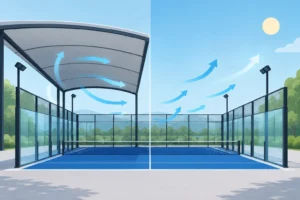
In the UK, rain, wind, low winter light and changing temperatures can disrupt an uncovered court programme. A covered venue reduces cancellations and protects utilisation during the periods when many players are most likely to want an after-work or weekend session. For commercial sites, this can change the economics of the project. Courts that remain bookable are better placed to support coaching, leagues, corporate events, memberships and regular repeat play.
The trend is also being driven by a more mature investment mindset. Early padel developments often focused on entering the market quickly. As operators gain experience, attention moves towards revenue resilience, premium positioning and operational consistency. Covered courts answer all three requirements when they are properly designed and installed.
This does not mean every project requires a full cover. In regions with a dry climate, or at a site where padel is an additional amenity rather than a core revenue stream, outdoor courts may remain the right choice. However, where utilisation targets are ambitious and weather disruption is material, a canopy can be the difference between a seasonal attraction and a year-round business.
A Cover Is a Commercial Asset, Not an Add-On
The commercial value of a covered padel venue begins with availability. Every cancelled booking is lost court income, but the impact extends further. Unreliable access makes it harder to build player habits, schedule coaching blocks and retain members who expect a dependable facility.
A well-planned cover also supports a more premium customer journey. Players arrive to a protected setting, staff can operate a predictable timetable, and events can be promoted with greater confidence. This is particularly relevant for hospitality groups, private clubs and high-specification mixed-use developments, where the quality of the physical environment reflects directly on the wider brand.
For investors, the question is not simply whether a canopy adds capital cost. The better question is whether protected court time creates enough additional utilisation and pricing power to justify that cost over the life of the asset. The answer depends on local demand, booking rates, land value, operating hours, energy strategy and the competitive supply nearby.
A feasibility model should allow for realistic occupancy rather than assuming every available hour will sell. It should also test different scenarios: winter trading, peak-time demand, coached programmes and the likely effect of adverse weather on uncovered alternatives. A cover may command a higher initial investment, but it can make the revenue base less exposed to the variables a club cannot control.
Engineering Must Match the Operating Ambition
A padel canopy is not a generic roof placed above a court. It needs to work with the court structure, playing envelope, local weather conditions, drainage, lighting layout, access requirements and the visual identity of the venue.
Clear height is fundamental. Players need space for lobs and overhead shots without feeling that the building compromises the game. The structure should preserve a genuine padel experience while offering protection from rain and excessive glare. Equally, columns, foundations and roof geometry need careful coordination so that they do not interfere with circulation, spectator areas or the court’s visual openness.
Wind and snow loads require particular attention. A design that performs well in one location may be unsuitable in another, which is why site-specific engineering and appropriate structural calculations matter. The canopy must be specified for the environment in which it will stand, not selected solely from an attractive concept drawing.
Drainage is another point often underestimated at the planning stage. Water management affects the condition of the surrounding surface, safe access routes and the long-term presentation of the facility. Good detailing protects the court area and reduces the risk of avoidable maintenance issues around the perimeter.
The best projects also consider lighting from the outset. Fixtures should provide consistent visibility without creating intrusive glare for players or unnecessary spill beyond the venue. In dense urban sites or near residential boundaries, this can influence both planning discussions and the operating hours a facility can support.
Court Choice Still Shapes the Premium Experience
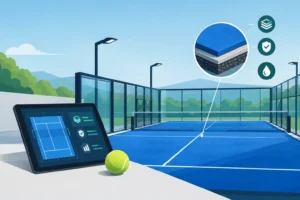
Covering a court does not remove the need to select the right court model. The court remains the centrepiece of the player experience, and its structural quality, glass finish, steelwork and viewing lines will be noticed at every booking.
Panoramic and full panoramic courts are particularly effective where visual impact, spectator sightlines and premium presentation are priorities. They can give a club a more open, professional environment that supports tournaments, social content and event-led activity. For facilities seeking a disciplined balance of quality and capital efficiency, a pillar-based design can offer a practical route without compromising the fundamentals of durable construction and high-standard play.
The right decision depends on the role of the venue. A flagship club in a competitive city market may need the statement value of a full panoramic installation. A tennis club adding two courts to broaden its membership offer may place greater weight on budget, phased expansion and integration with existing facilities. There is no single best configuration, but there should always be a clear rationale connecting the court model, cover design and commercial plan.
Planning the Site Before Production Begins
The growth of covered padel venues has made speed attractive, but rushed site decisions can be expensive. Before production, operators should establish the usable footprint, ground conditions, vehicle access, utility routes, drainage strategy and any local planning restrictions. These factors influence both the design and the installation programme.
Planning requirements vary considerably. Height, appearance, lighting, noise, traffic and the proximity of neighbouring properties may all be relevant. A proposal with clean architecture, proportionate scale and considered external finishes is easier to position as a long-term improvement to a sports site rather than an intrusive addition.
Site access deserves equal scrutiny. Components must be delivered, unloaded and assembled safely, while installation teams need sufficient working space around the structure. A constrained site is not necessarily unsuitable, but it demands more detailed logistics and a supplier capable of coordinating manufacture with the realities on the ground.
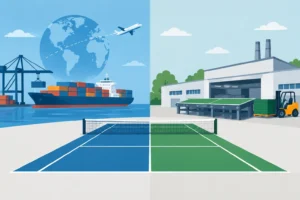
Working with an end-to-end manufacturer such as inCourts gives project teams clearer accountability between court design, canopy engineering, production and final installation. That continuity matters when tolerances, finishes and programme deadlines have to align.
The Operational Detail That Protects Returns
Once the venue opens, covered courts still require active management. Operators should set booking rules that protect peak availability, create a structured coaching programme and use leagues or ladders to generate repeat visits. Reliable cover provides the platform, but programming converts that reliability into sustainable revenue.
Maintenance should be planned rather than reactive. Steelwork, roof materials, gutters, fixings, glass and playing surfaces need regular inspection, particularly after severe weather. A premium installation is designed for long service, but longevity depends on protecting the asset and addressing small issues before they affect court availability.
It is also worth considering ventilation and player comfort. A covered court that feels enclosed, humid or poorly lit will not deliver the full benefit of year-round protection. The aim is a venue that remains comfortable and visually refined in changing conditions, not simply one that keeps rain off the turf.
Building for the Next Stage of Padel Demand
The most successful covered padel projects are designed with growth in mind. This may mean allowing for future courts, retaining space for a reception area or café, preparing utility capacity for additional lighting, or creating circulation that can accommodate larger events. Expansion is easier and more economical when it has been considered before the first foundation is poured.
For decision-makers, the opportunity is clear: build a facility that players can depend on, and they are more likely to make it part of their weekly routine. A properly engineered covered court gives a padel business something more valuable than protection from poor weather – confidence to sell, schedule and grow throughout the year.



No comment yet, add your voice below!