

A padel court quotation can look competitive until groundwork, drainage, electrical provision, access constraints and installation are added to the project. Effective padel project procurement starts with the complete operating asset, not the headline court price. For club owners, developers and operators, the objective is clear: procure courts that attract players, withstand intensive use and protect capital over the long term.
A premium padel facility is a visible revenue-generating environment. Its courts must perform structurally, look right within the wider site and allow the operator to open on schedule. Procurement decisions made before production determine whether the project is controlled or exposed to avoidable variations later.
Start Padel Project Procurement With the Business Case
The correct court specification depends on the commercial role of the facility. A flagship club in a high-footfall urban location may need panoramic courts that create a strong visual statement, support premium membership pricing and improve spectator sightlines. A tennis club adding padel may prioritise a durable, cost-conscious configuration that fits available space while maintaining an excellent playing experience.
Neither approach is automatically better. The question is whether the court model supports the expected customer, utilisation level and return profile. Procurement should therefore begin with projected court hours, intended pricing, peak-time demand, coaching activity, competitions and the role of food, beverage or hospitality revenue around the courts.
This early work also prevents a common error: specifying only the number of courts before testing the operational layout. Four courts may generate stronger returns than five if the larger spacing allows better circulation, reception access, player waiting areas and a more attractive social environment. Equally, a compact site might justify a more efficient layout where demand is established and the access strategy is sound.
Define the Full Delivered Scope
A court manufacturer should be assessed on the complete delivery requirement, not simply on steel, glass and turf. The procurement scope needs to identify where supplier responsibility begins and ends. Ambiguity between the court package, civil contractor, electrician and site operator is one of the fastest ways for programme delays and unplanned costs to develop.
The main scope normally includes court design and manufacturing, transport, unloading, installation, playing surface, lighting and any chosen canopy system. It must also address foundations, drainage, electrical supply, access for delivery vehicles, lifting equipment, site welfare, permits and final testing. Indoor projects introduce further requirements around building clear heights, ventilation, fire strategy and acoustic conditions.
Request a clear exclusions schedule alongside every quotation. It should state what is priced, what is assumed and what remains the client’s responsibility. This is particularly important for international projects, where local ground conditions, import procedures, crane availability and labour requirements can materially affect the final delivered cost.
A fixed court price is valuable only when the interfaces around it have been properly defined.
Groundworks and drainage are not secondary items
Courts rely on a stable, accurate base. If levels, tolerances or drainage are not resolved before installation, the consequences can include standing water, poor court alignment, additional remedial work and disruption to the construction programme. Procurement teams should obtain a site survey early and make sure the civil design reflects local soil conditions and rainfall patterns.
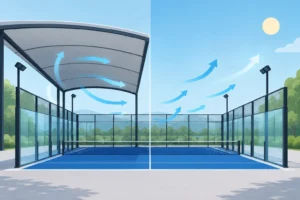
The foundation solution must match the selected court model, canopy loads and local engineering requirements. A covered court is not simply an open court with a roof added later. The additional structure changes the design conversation from the ground upwards. Where a canopy is part of the investment case, procure the court and cover as an integrated system rather than treating them as unrelated packages.
Specify Structure, Visibility and Playing Performance
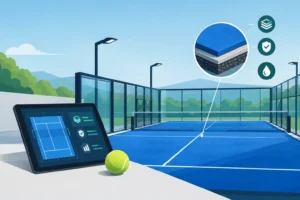
Not all padel courts offer the same structural strength, finish or visual impact. The right specification should address steel profiles, corrosion protection, glass quality and thickness, fixings, mesh panels, turf system, lighting positions and the detailing that affects both performance and appearance.
For exposed outdoor sites, corrosion resistance and drainage design deserve particular attention. In coastal locations or areas with demanding weather conditions, an apparently minor difference in coating quality or component protection can have major lifecycle implications. Ask how the structure is prepared, finished and protected, rather than accepting broad claims about durability.
Glass is equally central to the player and spectator experience. Panoramic and full panoramic court designs reduce visual interruption and create a more professional setting, especially where clubs host events, coaching or social media-led activity. However, the best choice still depends on budget, target market and the venue’s design priorities. A Pilar court can offer a high-quality, dependable solution where a more conventional structure is commercially appropriate.
Lighting should be specified for real use, not only minimum compliance. Consider player comfort, glare, surrounding properties, energy consumption, maintenance access and whether the club expects to operate at busy evening periods. Poorly considered lighting can undermine an otherwise premium court installation.
Assess Manufacturers Beyond the Brochure
Procurement teams should look for evidence of manufacturing control, engineering capability and installation experience. A supplier that understands the court as a system is better placed to manage design details, production quality and onsite interfaces than a reseller working from a generic product sheet.
Ask practical questions. Where is the court manufactured? Who is responsible for technical drawings? What quality checks take place before dispatch? How are glass, steel and turf packed for transport? What installation method is proposed, and what site conditions does it require? A serious supplier should answer clearly and align the proposal to the project rather than forcing the project into a standard quotation.
Commercial comparison should also account for programme certainty. The least expensive option may carry a higher risk if delivery dates, shipping terms, technical information or installation resources are unclear. A delayed opening can cost more in lost membership, bookings and staffing inefficiency than the initial saving on a court package.
InCourts approaches this requirement through in-house manufacturing, premium structural design and project delivery support, allowing clients to select from visually striking panoramic formats through to strong, commercially focused court models.
Build a Procurement Programme Around Critical Decisions
Long-lead components and site readiness must move together. Manufacturing cannot compensate for unfinished foundations, and completed civil works should not sit exposed for months because court production or shipping was ordered too late. The programme should connect design approval, groundworks, manufacture, transport, installation, electrical completion and opening preparation.
Before placing an order, confirm the approval process for drawings and finishes. Delays often occur when decision-makers have not agreed on court colour, turf colour, branding positions, lighting arrangement or canopy configuration. These details affect production and should be resolved before manufacture begins.
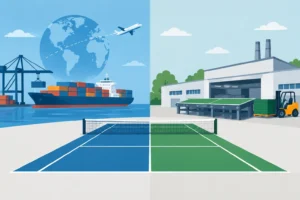
Transport planning also needs attention. Check access routes, turning circles, unloading space, local delivery restrictions and whether a crane or forklift is required. For constrained city-centre or hospitality sites, delivery logistics can be as significant as the court specification itself.
Protect the opening date
A realistic contingency is not a sign of weak planning. It recognises that weather, permitting, ground conditions and local authority processes can affect the route to opening. Build contingency into the civil works and commissioning stages, then agree who has authority to make decisions if a site condition changes.
The installation team should receive confirmed foundation drawings, site measurements, access details and electrical information before arriving. This enables work to proceed efficiently and reduces the risk of expensive standby time.
Treat Acceptance and Aftercare as Procurement Requirements
The project is not complete when the final glass panel is installed. Formal acceptance should cover court alignment, glass and steel condition, turf finish, lighting operation, drainage performance where relevant, fixings, safety elements and the completion of any snagging items. Record the handover condition with photographs and retain product documentation, care guidance and warranty information.
Lifecycle planning should be discussed before purchase, particularly for high-utilisation clubs. Turf maintenance, glass cleaning, checking fixings, lighting servicing and periodic inspection all support court appearance and safe performance. The operator should know what routine work is required, who can carry it out and how replacement components can be sourced if needed.
A premium court should continue to look like a premium court after thousands of booked hours. That outcome depends on the original specification, but also on practical maintenance planning and a manufacturer willing to support the asset beyond installation.
The strongest procurement decisions are those that make the opening day easier and the next five years more predictable. Set the commercial ambition first, specify the full delivered system, challenge assumptions in every quotation and choose a partner capable of delivering the standard your venue will be judged by.


No comment yet, add your voice below!